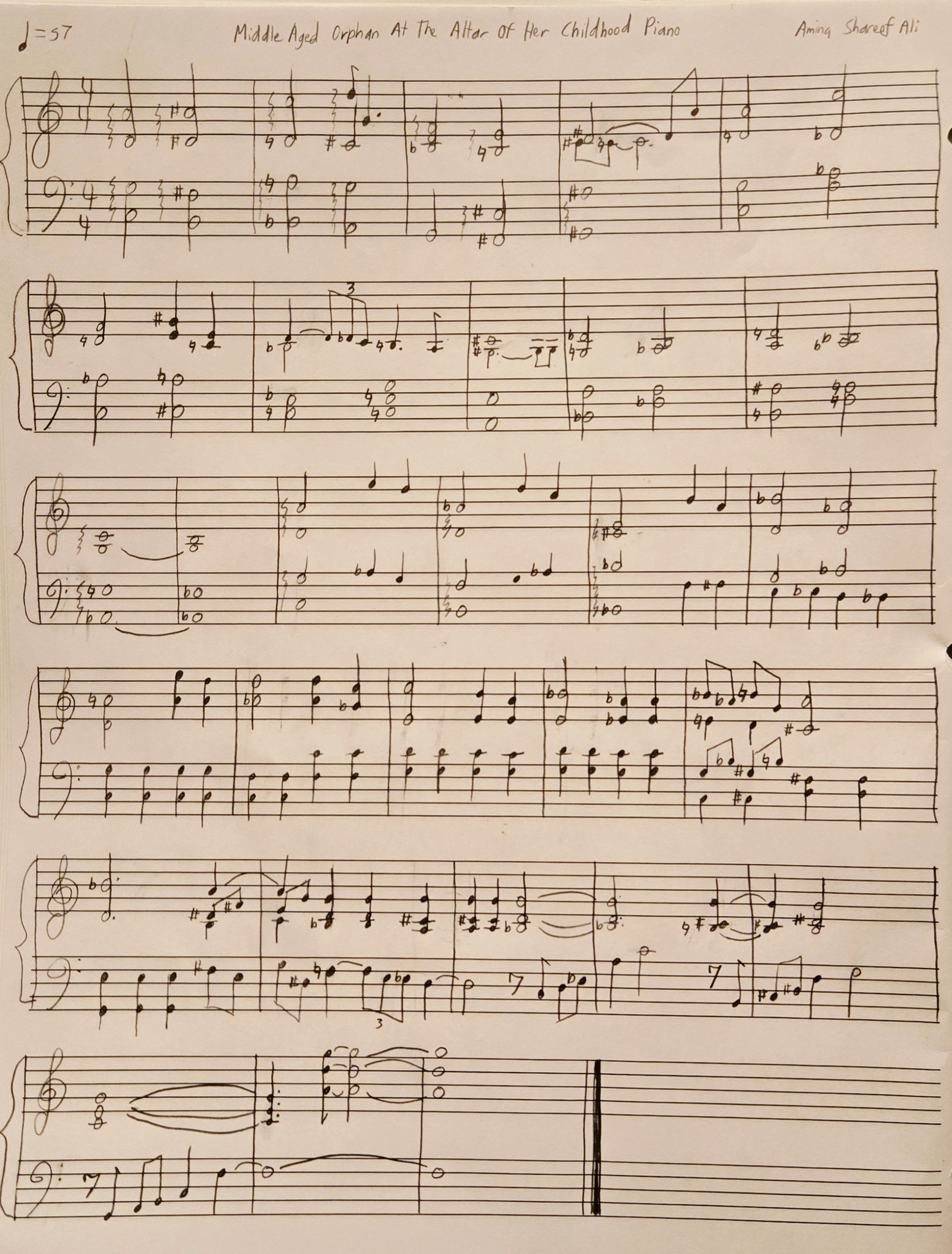
I referenced this in passing in my 2025 retrospective, but I’ve finally gotten around to writing out properly my first real (instrumental, in a “classical” or adjacent style) composition since I was in undergrad! In case you didn’t know, I studied music composition at Oberlin, which was both totally mind-bending and overall (trans)formative for me, and also a hugely uncomfortable warping out of any creative mode I had ever explored before. I think a full accounting of what that education taught me, what I value and what I reject, is…something I’ll delve more into some other time, maybe.
What I’ll say is this. As expansive as that period was for me, there had already been another kind of pruning happening of other creative modes (art, writing). Some logic that I had to both hone one particular craft and otherwise stay in my lane had already taken hold, and wouldn’t really let go until 2015 or so. And you know what, it wasn’t the worst thing in the world; it was during this time that I really went into the woodshed as a songwriter, and maybe I couldn’t have become the songwriter I am without it. But somewhere in there I lost a sense of play: not just in the sense of noodling in a low-stakes way, but also just getting curious, feeling into deeper experience, not judging.
“Middle Aged Orphan at the Altar of Her Childhood Piano” is just that. Two and a half years ago, a year before she died, my mom shipped out to me, at significant expense, the piano that had been my dad’s tenth wedding anniversary present to her. My brother and I both took lessons for years on it. And for the first time, I had a home where I not only had space for it, but could play it at any time of day or night. And as the title suggests, it doubles as an altar. I sometimes sit here for five minutes, or twenty, at the end of a night, communing with my parents, and feeling into the sounds that come out, how they sound together, how they move against one another, where they pull and rest. And it feels very good to come back to this register of creativity, but with two decades (!) of life and maturity under my belt, nothing to prove anymore (musically, anyway).
I started out improvising the first chordal phrase (after Satie’s “Chorale Inappetisant”), and then made some decisions* about the the piece and my method: 1) it would be a chorale with four voices; 2) I would mostly follow my ear and not analyze what I was writing in real time with chord functions etc. 3) voice leading over chord spelling; 4) I would be able to play it (I’m still not up to snuff with a recording for socials, but I’ll get there soon). Also, I made the decision not to fuss with ‘proper’ functional spelling of certain harmonies~ C-flat and so on~ because I think the tonal centers are murky enough to not really be worth the trouble.
Okay, without further ado~
*per my late teacher Randy Coleman, “The first step of creativity is constraint.” Inna lillahi wa inna ilayhi raji’un.
For the first time in some years, I felt compelled to write a full-on blog summary of my year. Put simply (and obviously notwithstanding the ongoing and mounting horrors), this has been my best year in quite awhile. Put another way, in 2019 I experienced a devastating personal loss, and have not had anything I could really call a ‘good year’ since then. Which is not to say that I haven’t accomplished things, or had rewarding experiences; in 2022 I wrote the lyric, “the past few years have been the hardest of my life; I’m the best I’ve ever been”, as a celebration of my dedication to growing, making meaning and cherishing the entirety of my life, not just the summery times.
None of this is to say that this year has been easy; at the beginning of it I was in a pretty rough place, depressed and burned out, such that I took intermittent leave from work for the first several months. I think that the shifts that have occurred have been due in equal measure to my own efforts, external supports, and serendipity. I’m striving every day to be humble and grateful for all three, but placing the most focus on the first, since it’s what I can control. I’d like to do some accounting of that here.
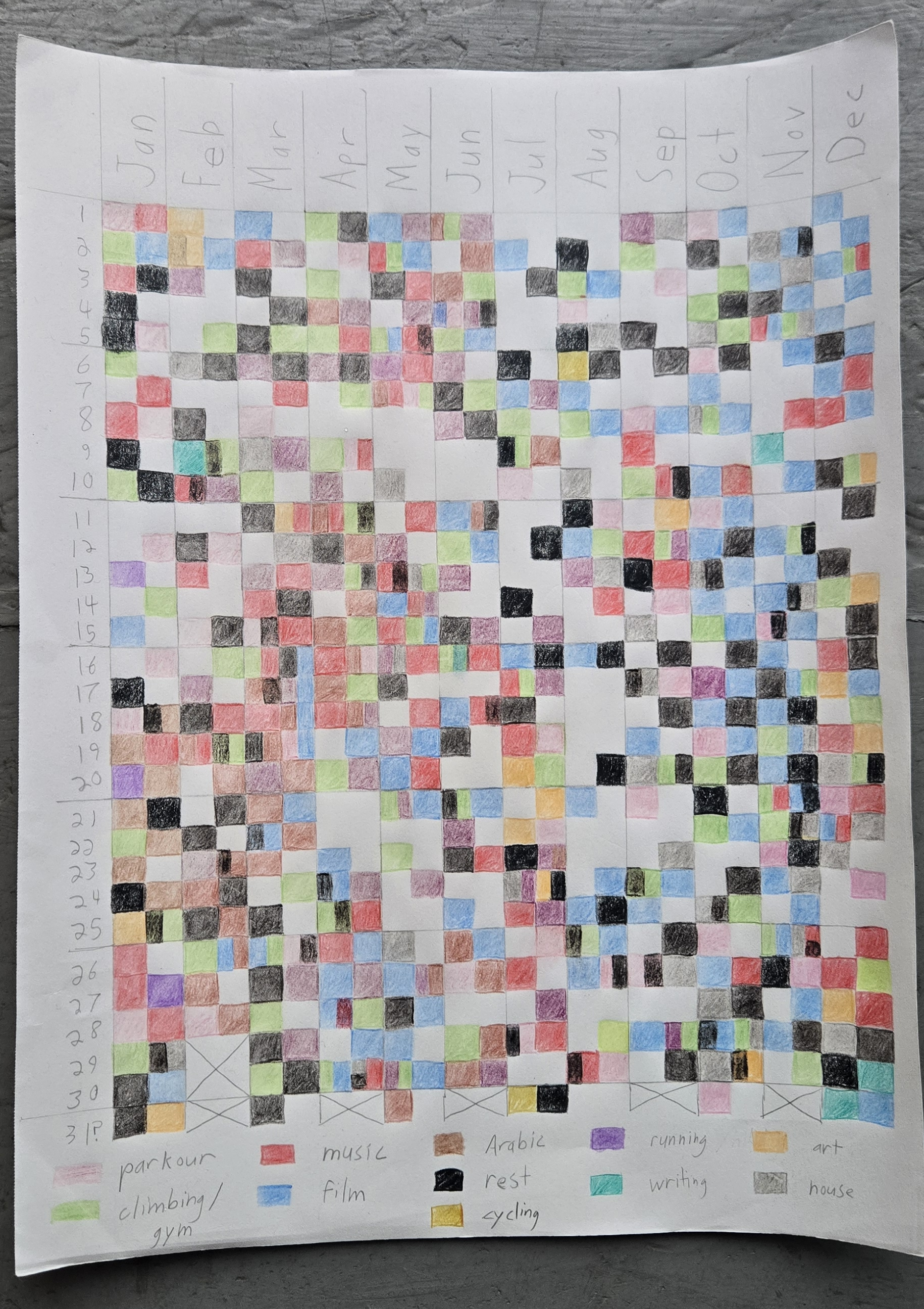
Let’s start with my projects and practices daily tracking chart, pictured here:
I got the idea for this after seeing parkourist Lisa Eckert post her previous year’s chart early in the year, and decided on impulse to mock one up and begin tracking, filling in the few days that had already passed. I started with five categories (parkour, climbing, music, film, Arabic) and ended up adding six more (rest, running, writing, art, house, cycling) as the year went on. My notions about what constituted an instance of each category also got more defined as I went, with a general ethic of ‘give yourself credit, but claim no easy victories’. That is, I wanted to notice and appreciate the accrual of intentional practice over time, but also be honest with myself about the ‘intentional’ part (e.g. diddling around on my piano for a few minutes before bed isn’t bad, but it’s not the same as practicing with purpose).
Here, then, are how I ended up defining the categories:
Parkour: a proper session, not just futzing out in the wild. Usually at least an hour, and recording something to reflect on.
Climbing/gym: this bucket was just climbing at the beginning of the year, but in March I shifted to more just upper body strength training, mostly in the gym but also with bodyweight or whatever when I was traveling. It still feels like it all belongs in the same bucket though, since it’s all focused on upper body, mostly to the end of strength and conditioning (as opposed to aesthetics, as with parkour).
Music: defined as practicing at least two of my songs; writing something; recording something; or learning a cover song.
Film: half an hour or more of deliberate work on any aspect of the film (writing, rehearsing, production meeting, etc.)
Arabic: focused practice involving writing, speaking and recording.
Rest: eight or more hours in bed, falling asleep relatively quickly and no notable wakeful periods.
Running: any running session, always a mile or more.
Writing: any creative writing, generally at least a half hour.
Art: any drawing or painting, generally at least a half hour.
House(hold): repair, improvement, or any non-routine household logistical figuring that would lead to an improved or more organized home or state of affairs.
A thing to know about these categories is that they don’t capture a lot of aspects of life that I do consider quite important and valuable: parenting, routine household operations, my paid therapy work, or interpersonal relationships. I specifically wanted to capture projects and practices. Things I had to make a point to work on and keep moving forward–either toward a big goal like a film shoot, or towards trying to make or maintain routine–but that I knew would feel specifically rewarding and resourcing to me. As in, these are the things that can get blown off by orienting too much towards others. Sometimes work in these areas would also benefit others, as with the household category, but each category had to have a certain ‘for me’-ness for the chart to feel meaningful.
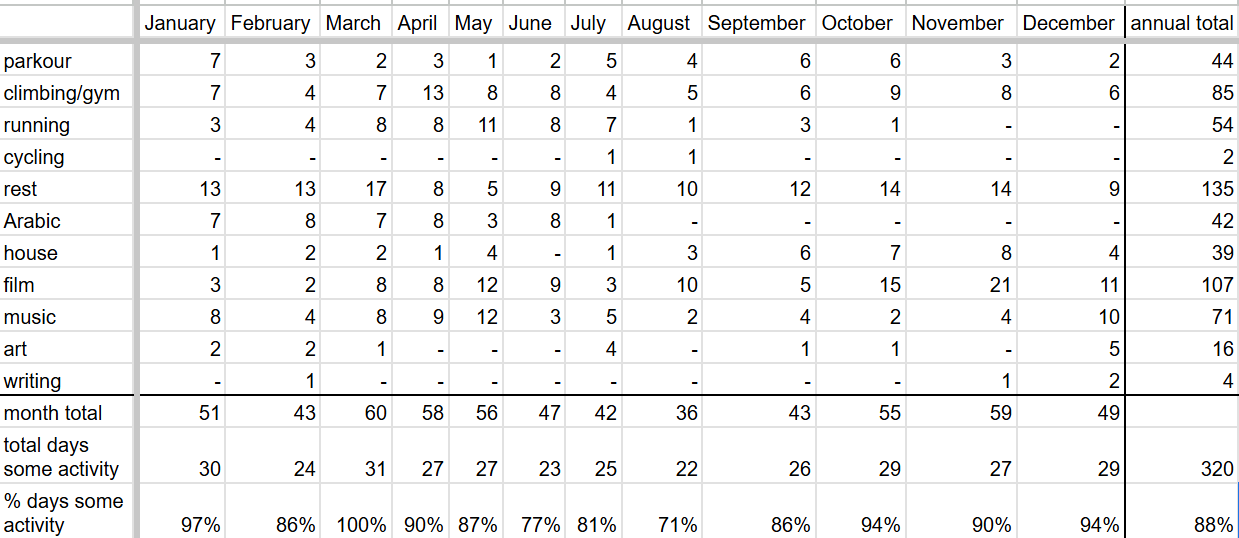
I feel like there’s a ton of analyzing that I could do of this data if I had the time, but not to get bogged down, here’s the quick and dirty spreadsheet I threw together:
I could also use these numbers as a jumping off point for goal setting (what if I aimed for doing something toward my goals 90% of the days of the year? What if I aimed to get good rest 40% of nights?); but on the other hand, you know what, y’all? Looking at this, I actually feel really fucking accomplished and proud. I think it would be a mistake to immediately try to level up without just noticing and appreciating what I did, and that this tracker helped me do it. So if you’re wondering, I really can’t recommend doing something like this enough. What it helped me do more than anything was to notice. If it had been awhile since I’d touched any of these, to get to choose to return, or to adjust my goal or intention. If I had been fairly consistent, to appreciate and savor that. I think it helped me feel more satisfied with what I had and less prone to resentment when it was time to pivot to other things. And if a day had afforded me no hours to focus on my stuff, I could at a minimum always try to get some decent rest, and really regard that as a gift to myself.
Okay. To contain the Nate Silver-ization of my creative and spiritual life, let’s get into some qualitative reflections. Fair warning, I’m writing this mostly for myself, so feel free to get off the ride if you’re not trying to dive deep into my process. Some of these things I also wrote about earlier in the year in IG captions as the things happened.
The crown jewel here is, of course, the film shoot. In case you missed it due to its relatively smaller social media footprint: at the beginning of December we had a three day shoot for a short proof-of-concept version of my screenplay I Came Back To Life. I’ve been working on this script and story since 2021, and have remarked many times since that I had no idea what I was getting myself into. Even at a ‘microbudget’ scale, filmmaking takes a pretty dizzying amount of resources of time, money and dedication on the part of many people. And then the more micro the budget relative to the scale of the vision, the more the time and dedication ratios go up. I know people who have been in the film space for awhile know all this; but shit, I really got learned up by it. And I’m so damn grateful for it, truly. I couldn’t believe how fun it was to be on set, or how much the early footage has blown my expectations out of the water. I could go on and on about this, my biggest project, but to keep the focus more on my process, I think this was the year I actually became a Real Boy, by which I mean a filmmaker. I love becoming new things. I hope I never stop.
My music is a big part of the film, so focusing on that project doesn’t feel like a departure from my first love. But all the same, I’ve had to do plenty of juggling and reordering of priorities ongoingly this year. Early in the year I bit off a ton with all my projects, such that at a few points in the year I had to remark, ‘you know, my life is really, really good, filled with good things that I wanted and asked for–and, wow, I’m pretty stressed out, and am looking forward to my next break’. I’m proud of the way I was able to dance with this pressure and set some things down with care and appreciation. With music, this looked like a pretty hectic gearing up for a full band recording session back in May for a new record. We tracked three songs, one of which has already been released on the Trans Of Noise comp to benefit the PCRF. The others are gonna wait until there’s enough spaciousness for me to turn my attention back to recording. It’ll happen.
I had a lot of peace around this setting down; but for the last few months of the year, I started to feel this itch to write a song before the year ended. I knew that music and songwriting in particular are old, dear friends and our relationship is still strong even if we don’t connect for awhile; but I also just knew it’d feel good. So a few days ago, after contemplating it for a couple months, I sat down and finished writing “Poison”. I’d already had most of the elements sitting around for a year or two. The baby was full-term and ready to come out, but I needed to push. I did, and then as predicted, I fell in love. It feels good to relate to songwriting this way, regarding each new one as the gift it is.
Then in total left field musical news, I’ve also composed as many as three piano pieces this year! I say ‘as many as’ because one is just a little 16 bar progression that loops, and the second is kind of a jazz head from two tone rows, with a reharmonized contrapuntal coda using the same two rows. That is, the first two are kind of on the edge as far as being fully-formed compositions, especially as I’m not a good enough player to deliver on the potential as an improvisational vehicle. But the last I would daresay is a bona fide piece. I don’t have the sheet music or a polished enough demo of most of these yet to show y’all, but soon I hope. Principally what I’d like to note for now is that it’s sweet to come back to this register of creativity in a low stakes playful way, which is an advantage of having your childhood piano in your detached garage apartment where you can play at any hour of the night.
Moving on: moving my body. I did it some this year. The most legible achievement was probably my half marathon, which again I venture might be my last. I think the main things I’m inclined to celebrate about it were that 1) I trained wisely for it, calibrating ongoingly to how my body was taking the stress of it, and did not injure myself! 2) I had been fantasizing about running this route as a half marathon for probably ten years. It’s satisfying to prove to myself that sometimes harebrained ideas of mine that lay dormant for hecka long can still eventually germinate and sprout.
I also embarked on a mission starting in March to regain my pullup, something I could do as a younger adult. That was before eight years on hormone replacement therapy and getting a lot heavier (NB: I am good with my weight and don’t want to lose it, but it is just objectively more to lift). I’m still probably months away from my goal if I hit it hard, but I have gone up by 40, 40 and 80 pounds on my pullups, lat pushdowns and dips, respectively, over the past nine months, and am objectively pulling more weight than I did when I was younger. She’s strong, folks!
I haven’t trained parkour nearly as much as I would have liked, and it’s less satisfying to do when one isn’t as regular and thus maximally fluid and mentally strong. One thing I am grateful for is to notice how much I miss and still love it as, to my tastes and body, the ideal marriage of physical training and art form. However I might shift focus in a particular season, I hope and believe I’ll keep coming back to parkour for many years.
Another one that I had to make the choice to set down was Arabic practice. This was the third time I’ve tried to study this ancestral language, and had to step back after a time and reevaluate. Folks, it’s just both very hard and incredibly fraught for me. This year, I tried self-study (after a previous community college course and a private tutor). In some ways I felt diminished anxiety and greater agency in directing my own learning without outside attention, but it was also a recipe for a fairly sprawling, inefficient process (if I wanted it to be meaningful and not completely rote). I do think I’ll come back again when the time is right, and probably front load with some purposeful curriculum creation, and a plan for how to bring it back to connecting with other people, which arguably is the point of language. But also, where cultural inheritances are concerned, it’s so easy to end up trying to adopt others’ meanings and lose one’s own. So again, I am grateful to have gotten greater clarity through my practice of what this learning means to me.
Speaking of connecting with other people: this was the year I came back to intimate relationships. Hard to know how much to share here in this public space, with respect to my own vulnerability and others’ privacy, and the fact that it’s all still in process. But suffice it to say, since my world historic heartbreak in 2019, I had yet to really get back on the horse of being able to reapproach new connection in a way that felt steady and safe, despite really missing it. And since at least late 2022 I had been in an extremely dormant place of surrender, trusting that the universe would bring it back around for me if or when it was time. That’s about all I’ll say here and now, but someday you’ll probably hear a song or two that lays it more bare. I won’t shout out the honeys here but they know who they are, and that they’re appreciated.
Maybe you’re thinking, ‘Amina, Jesus Christ, how do you have time to date with all the shit you’ve been doing’. Well yeah! It’s been a lot of balancing, managing mine and others’ expectations. But a big thing that I learned is that if one has taken time away from being out there and cultivated a lot of other projects and practices that feel meaningful, to deprioritize or drop those things the second a new cutie shows up in one’s world is really to dishonor and devalue oneself. At some point I realized that any new connection would need to start ‘in a small pot’, so to speak; what space it might grow to fill in the larger garden of my life was TBD, but wouldn’t happen quickly in any case.
Meanwhile, not only did I have a lot of other fish to fry, but I also seem to keep getting older and needing more rest! This was the first amended category to my chart. The real impetus was how bad my migraines had gotten in 2024, with inadequate sleep really being the prime suspect. As it turns out, I think the picture is a bit more complex than that, but committing to getting more sleep to try to get relief there has also helped me to reconnect with my body, how it actually appreciates being adequately resourced (who knew). There’s literally no goal that didn’t benefit from having enough in the tank to have greater mental and emotional clarity, less aches and fatigue. And I’m pleased to report that I only had thirteen migraines this year, down from seventeen last year! Onwards and upwards.
We’re getting there folks! Just a couple categories left to reflect on.
The ‘household’ category morphed somewhat over the course of the year, from being primarily to do with physical projects on my home, to having also/mostly to do with conversations about money, and how to manage it responsibly and in line with my values. This one still feels pretty private, but it is a process I want to name publicly, and also invite people I’m in direct relationship and community with into conversation around it.
With regard to art and writing: neither of these did I have any specific goals around, but I did want to appreciate when they called me and I answered. In particular, it felt sweet to return to poetry after about twenty years; another of those registers of creativity that I had eschewed out of respect for the craft, but maybe gone too far into denying myself permission just to explore that way of expressing, seeing, being.
Lastly, I want to record here some intentions that I wrote out for a ritual (we were specifically prompted for thirteen, which took some digging). In the order and parlance that they came to me:
I will keep the faith for my longer term projects.
I will keep playing creatively for its own sake.
I will keep giving my body rest and movement as it asks, and before.
I will have grace and gentleness for my body when it hurts.
I will keep returning to hard, uncomfortable work that’s aligned with my values.
I will stay present and intentional with my parenting.
I will stay present in my relationships, orienting to my desire.
I will stay oriented to my practices.
I will keep working to accept the finitude of life.
I will strive not to resent the so-called drudgery of the everyday.
I will try to shift my ambitions and capacities into greater alignment.
I will keep trying to do normal things with greater quality.
I will bring myself fully to the present moment.
As I write these out, I’m reminded of my friend Bianca Beyrouti, who passed on the second day of this year, one day after publishing this intention-setting post on her own blog. The thing is, as painful as it is to mourn someone with such hope and intention (and vision, and integrity, and light,…), doesn’t mean there was anything wrong-headed about the orientation. It really is a riddle with no answer, knowing that we might have forty more years, or none, and trying to come up with a satisfactory strategy for both scenarios. In light of this, are any of us ever ready for death, or for life? What does it even mean to be ready?
Obviously these questions spill out of the scope of this seat of the pants year end reflection. But I think what I’ll take some gratification from, and keep as my pole star, is that I’ve been learning a lot about what it means to live well with both outcomes hanging in the air, equally possible as far as any one of us knows. And I want to have gratitude that this learning happened through 2020, 2021, 2022, 2023 and 2024. Please know that I’m only talking about my own life and trials here, but: none of those years were good per se, but maybe they weren’t bad either. They were hard, they contained plenty that I didn’t choose or want or have control over. But I couldn’t have learned the things that made 2025 great (for me, in particular ways) without walking through the fire of the previous half decade.
Here’s to a 2026 where we all live as long and well as possible.
The following is my speech from a memorial for my mother held on November 19, the day after her what would have been her 76th birthday.
I want to remember my mother, and I want to remember her with you, together. I want to tell the truth, my truth; I want to hear your truth as well, and weave them together into a single garment; and I don’t want the biggest truth to get lost. The biggest truth is that she is loved, she is missed, and she is cherished.
I have a pretty good memory from adolescence on, but before that, especially before my father died, is pretty fuzzy. One of the earliest specific moments that I can retrieve of my mother is of us playing in a swimming pool together. I remember floating on my back and her pulling me along through the water, and just beaming down at me with love. I must have been around 7 or 8–making her about the age I am now–because I can recall being young enough to bask in my mother’s love, but old enough to feel embarrassed by it. The ache of this tension feels symbolic of how we would struggle to feel close with each other throughout life.
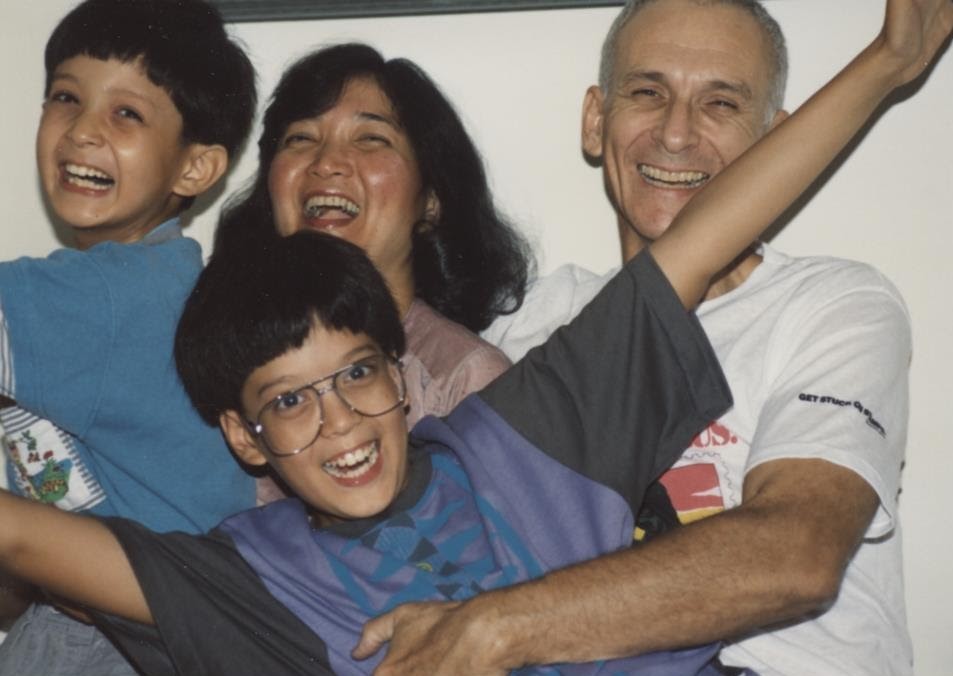
Myself, my mom, my dad, and my brother.
For better and worse, my father’s passing was a demarcation point in all our lives, changing us as individuals and in our relationships with each other. I want to tell the truth about the pain of this, the way our relationship gnarled like a tree around a fence. My mom would tell me that I was her pride and her joy; still it was hard not to feel that I was hurting or disappointing her with my failure to excel at school, that tentpole of prudence that seemed to be our most core family value. I could offer my mother tender care by plugging in her hair curlers for her in the morning before she woke, or having the dishes washed and table set when she got home from work. But the psychological injury of losing one parent had pinioned my ability to be emotionally expressive with the one that remained; as often as my mother would tell me she loved me, it was years before I could say it back again. Thus gnarled the branch, back and forth.
The critical thing to know is that the branch found its way. It’s easy to see in retrospect, but in the moments as they were lived this was never a foregone conclusion. My mother lauded my sensitivity and creativity; yet I found it difficult to feel seen by her. I did not flout getting a college education to start a band, though I did finagle that time of my life towards making some pretty weird art and sowing the seeds of my future queerness and leftism. And each time I ‘came out’ to her again–as polyamorous, as transgender–I braced myself for the possibility that this, this was a bridge too far. It never was.
My mother’s speech at my wedding.
At the same time, there were limits. When my personal and political development led me to wanting to trace back through history to ancestral roots, it was hard to elicit much about her childhood and adolescence in the Philippines. I think we were both a bit vexed and perplexed by this; it wasn’t until near the end of her life that she connected the dots for the both of us. That in order to be true to her own heart, she had had to leave so much behind. When I did the same thirty years later, she wouldn’t begrudge me that; but in turn, I had to honor that, while she had no wish to withhold anything from me, the world she had the most ready access to was the one she had built for herself.
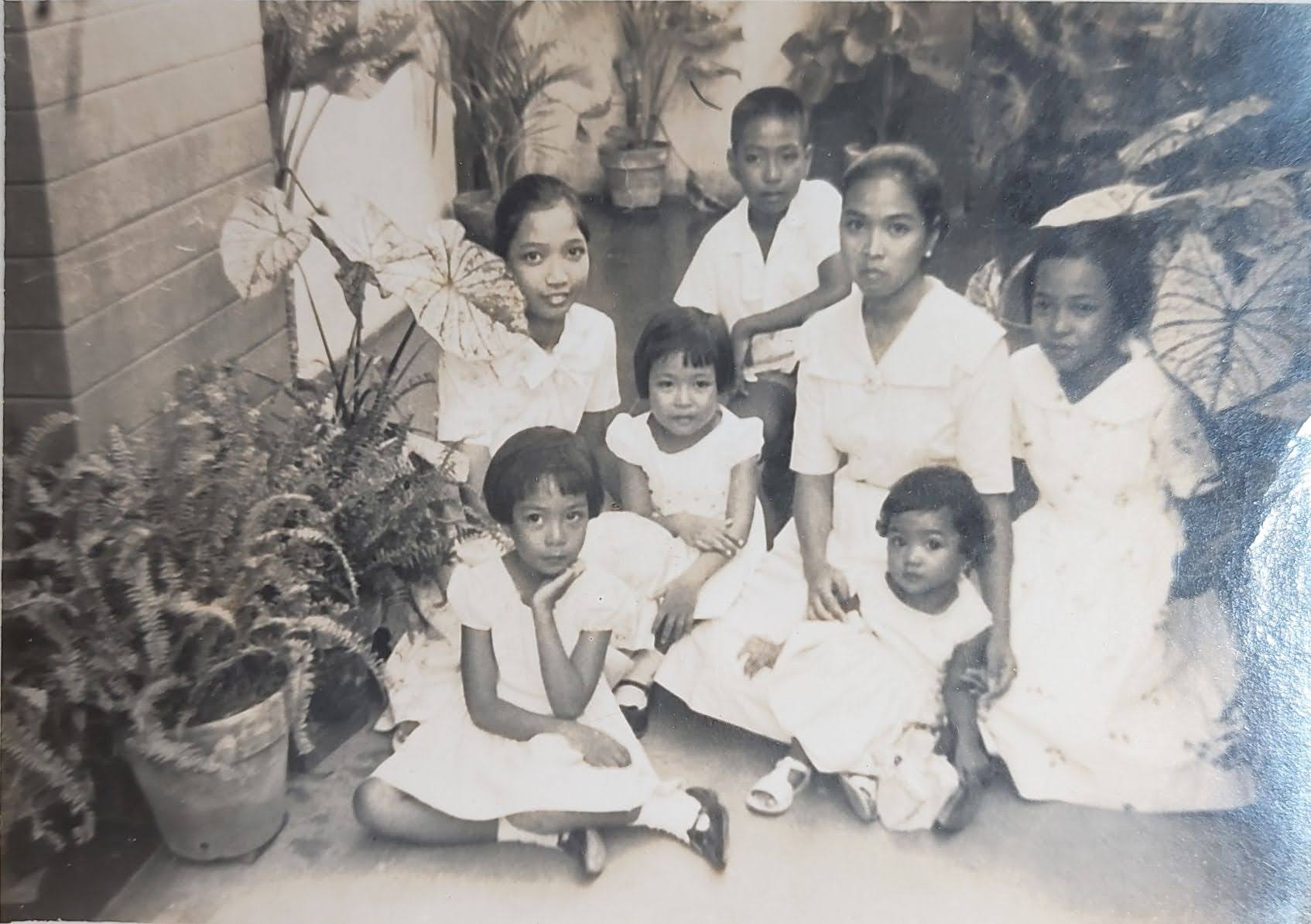
My mother (top left) and her siblings.
Still the branch wove and wended. This circuitousness is a challenge for my emotional and relational style, which has become something quite direct. What we eventually figured out together, without ever saying it out loud, is that we got the most mileage from a sort of ‘walking alongside’ one another. Rather than me grilling her to dredge her memory for some unknown detail decades in the rearview, talking about something like what we were each making for dinner might lead us to surprisingly rich and connective territory about how we each grew and learned and taught ourselves to be who we were, who we wanted to be.
At my graduation from therapy school, 2017.
And something that feels clearer now, after the end of her life, is that academic or professional success was never the prime value as an end unto itself. It was a means, a vehicle for securing and protecting other values which were conveyed more subtly, that also told about who we were, or aspired to be. That we’re loyal, and hardworking, and resourceful. That we take care of our people, and our things. But also that isn’t all drudgery and sacrifice: that we like nice things, the pleasures of life. My mother was so grounded in these core truths that she was able to take in the rough odds of the last chapter of her life, and commit to playing them out with honestly startling equanimity and grace, heeding the simple logic, “There is so much to live for.”
Mom and Hazel.
In the end, I got two decades of adulthood to really choose how I wanted to relate to my mother. As critical or dissatisfied as I might have felt at many points along the way, I’m so grateful for all of it now. By the end, our relationship was the best it had ever been. The truth, then, one more time. My mother and I struggled to feel close with each other throughout life. Struggled: meaning that we strived, tired, jostled, contended; but not to say that we failed. We had our moments, and these were enough and are enough. My mother herself was enough: strong enough, loving enough, tender enough, tough enough. She was more than enough. And she is loved, and she is missed, and she is cherished.
A version of this piece originally appeared in the parkour zine Once Is Neverin May 2022.
Beginning a practice of training parkour over the past year or so has been nothing short of life-changing for me. As a queer punk trans girl who has always been too weird and sensitive for the culture of sports–and who possessed almost no natural athletic gifts–it was almost unthinkable that a physical activity could be anything but torment or drudgery. I could wax poetic for a long time about the myriad benefits parkour has brought into my life, not least of all forging a joyful relationship to moving and exerting my body for the first time. But when someone recently asked me simply, “What is parkour?” I found myself at a loss for a satisfactory reply.
Of course I know the pat responses: ‘efficient A to B movement’, ‘a sport that involves running, jumping, climbing over obstacles’, ‘the French martial art of running away’ and so on. But none of these really seem to capture either some universal essence or what parkour is to me.
In attempting to answer this question adequately, something I’ve learned is that I am not an originalist. For starters, we could debate parkour’s exact provenance; the most widely accepted narrative, of course, is to regard David Belle as the father of parkour and the rest of the Yamakasi as a supporting cast. Yet in the history given in Julie Angel’s Breaking The Jump as well as the films Jump London and Generation Yamakasi, I see a much more collective and collaborative process–and there was plenty of intragroup discord surrounding both the philosophy of their training and its direction, almost from the jump. (See what I did there?)
At some point in the process of sifting through these different attitudes and values, I realized I’d done this once before. For over twenty years I’d wrestled with the question of what it meant to be punk. Was it in being fiercely dedicated to DIY, egalitarian art spaces? Or in being raw and real and not too concerned with polish? Or was it just in figuring out which people and artists were Truly Punk, and forsaking all others?
Just as I’ve been doing with parkour, I tried to answer this question by trying to follow the thread to its source. And lo, there was never a consensus among punks, either, about anything that constituted either punk music or culture: not about definitions, or aesthetics, or values. Of course, there were values and aesthetics that had drawn me in in the first place, as I mentioned above; but many of those features only emerged later in the culture’s development. In fact, some of the early examples of what would come to be known as punk were barely recognizable as such to me; interesting, but not particularly compelling.
And many of the characters who were around were not who I would think of as my people. There were those a bit too enthralled with shock and sensationalism at whatever cost, or those a bit too comfortable “ironically” espousing fascism. It took me a long time to understand that in order to find my place within punk, I had to be an active participant in the conversation about what punk is, and could and should be. Which, paradoxically, meant that I had to believe in my rightful claim to being punk in the first place.
I’m trying to really own that I can do the same with parkour. It’s a relief that I don’t have to subscribe to an ethos of arrogant superiority, masochism and hypermasculinity vaunted by certain old school heads, including David Belle; that there are counter streams of thought within parkour that are equally valid, of radical inclusivity and treating one’s body with care and even gentleness. But I don’t just want to reject some notions and embrace others; I want to take the meanings that resonate most and sharpen them. And the new meanings I make will be informed by who I already am–among other things, a middle-aged anarchist punk trans woman. So here’s my first go of it.
Parkour is a movement practice first developed in France in the 1990s, predominantly by Black and Vietnamese youth from immigrant communities. These youth were profoundly shaped by the forces of patriarchy, white supremacy and colonization as they played out in their built environment, in their families and in their psyches and identities. There isn’t a single unifying meaning to what parkour is at its core: not efficiency, not strength, not usefulness, not creativity. But what we do seem to agree on is that our movement means something, and it isn’t merely exercise, recreation or competitive achievement. To train parkour is to strive for this meaning.
For me, then, parkour is about claiming public space for things other than working and shopping. Parkour is both discipline and play. Parkour is knowing that as long as I’m alive, I have a body, and I’d do well to start enjoying it, better late than never. Parkour is giving as much to my body as I expect it to give me. Parkour is building rapport and trust with my body. Parkour is knowing that my body likes to be pushed, as long as I honor that it has limits. Parkour is always seeking the edge of what is possible, and accepting again and again that the edge is real and must be respected.
All of these meanings are partly derived from ongoing conversations with other parkour practitioners, but in reformulating them I’ve made them my own. These were the threads I chose because they helped me to grow while also integrating with all the identities I already had. That is to say, to me parkour is–or can and should be–egalitarian, liberatory, DIY, raw and real.
I’m someone who cherishes most of the younger versions of myself, and a corollary of that is that I also cherish a good deal of the art that I’ve created over my lifetime. There is a fair amount of cringe in there, of course, but often my prevailing feeling is “damn youngblood, you had heart even back then”. The ratio on the work that follows here is something like: 30% mildly embarrassing to somewhat mortifying; 30% kind of precious and endearing; and 40% “damn youngblood, you had heart even back then”. Apparently, that’s balanced enough that I’d like to put it out in the world and let it complete its life cycle.
The basic premise: this was the story and script for what I intended to eventually be a graphic novel; I didn’t know or worry while I was writing it about who would illustrate it. It follows two sets of characters, who are alternate timeline versions of each other: Charlie Johnston (whose respective versions go by the names Chas and Lee), Andrea Apostoloff (And/Rea), Jeanette (John/Annette), and so on. The timelines split sometime around when they all graduated high school, and they’re all around 22, 23 now. It’s fiction, but the life stage challenges and worldly concerns of the characters do absolutely reflect my own at the time: mainly, how to be a male (sic) feminist, how to do polyamory, how to make meaningful art and generally how to be a decent person who cares about justice.
Normally I agree that disclaimers are to be avoided, but there’s simply no way that I could let this see the light of day without naming some of the things I didn’t know a fucking thing about when I wrote this, which include zines, the art world, tarot, being an independent musician, audio recording and engineering, journalism, queerness, transness, abortion clinics, feminism, radical politics in general. I don’t think I had even really considered the concept of doing research for creative writing? But there’s no cleaning this up, folks; either it goes out into the world as is, or it just disappears. So, if you either like me as a person or my work enough to leaf through it, I thank you for both your audience and your grace.
This blog post and music video were originally conceived of as part of my process of coming out as a transgender woman. As life would have it, I felt the imperative to come out in a much more pragmatic manner before all these pieces were in place–and then two years passed. But I never let go of either the intention or desire to tell my story, so here it is.
Every history is related through the particular distortion of the present moment of authorship, including this one. Had I written this in the immediate wake of my coming out, I think I would have spent a lot of energy stressing that the dominant trans narratives–of being “born this way”, or having a lifelong experience of dysphoria–didn’t fit me at all. I would have really railed against the notion of gender identity as an Essential quality of the self, when my own experience of all aspects of my self is much better described as Emergent. I still basically hold with this, even though two years of reflection have also given me the opportunity to pick out instances over my life that I could weave into other patterns and narratives. I’m really not trying to retcon my life and say that I was always trans or always a girl; but I do think the potentialities for it abounded over the years.
I mean, I recall as early second or third grade wondering if it was possible for someone to be a boy and a girl at the same time, and what that person might look like. I remember a period of upwards of a month in middle school where I had a running serial fantasy of–hoo buddy, this one’s kind of vulnerable to write out–being in a lesbian sorority. Mind you, not some heel who stumbles into this forbidden heaven; no, I was definitely one of the girls.
But like I said, I’ve no interest in revisionism. Sure, I was a weird freaking goofball kid with big feelings who talked and sang too loud, but I didn’t really object to being a boy. Around the same time I was trying to dream the Girl-Boy, I also recall my first sense of, “Whew, I sure lucked out by being a boy. Being a girl, that would be…worse.” Packed into that worse was both a sense of inferiority and a poorer lot in life. Through grade school and adolescence, I found the male friends and social circles who would take someone like me, and you know I bought into heteronormative notions of romantic love. I could go off on a long tangent here about my patriarchal conditioning but Christ can a trans girl get a damn break from having to show her work around unlearning sexism? I’m trying to tell a story here.
My first clear foray into feminine expression came in tenth grade after poring over pictures of Syd Barrett. I remember feeling such a perplexity of disgust and allure with his style; in particular that he always wore colorful scarves. Flash forward six months or so, here’s me in my tenth grade yearbook photo:
And then wearing silky women’s shirts from Goodwill, or makeup and a dress onstage for my high school band’s last show. Relax, it’s just rock and roll, all right?
I passed through much of my twenties being impossibly emo and developing an unnerving pattern of being romantically involved–somehow?–with girls who were ostensibly lesbians. I have never been read more savagely than in the following tweet:
At the same time as I was proximal to so many queer women, I also felt uncomfortable describing myself as even “bi-curious”, because let’s face it, I’d only ever kissed two boys and given one-third of a handjob (the middle third, too: objectively the least exciting part). It took almost that entire decade to give myself permission to claim queerness (more about that here); to realize that if I stayed away out of some convoluted notion of not wanting to be appropriative or some shit, I would never give myself the chance to explore that part of myself. And for me, this shift was also about giving myself permission to explore femme gender expressions as well.
(In case it needs to be said: I am only trying to describe my own process of gender exploration, not anyone else’s. In particular, for me there is some blurring between the notions of femininity and womanhood, which I know doesn’t resonate for many butch trans women.)
Meanwhile, let’s look at the songs I was writing. From “Come Closer” a song I penned in 2007 for my ex from two years prior: “If we’re lovers that don’t make love, then that doesn’t seem unfair.” In “The State Of The Garden“, written 2009, I pretty much outline the platonic ideal of the Ambiguous Tenderqueer Hangout:
I arrived to pick you up at eight; per your request, we don’t call it a date. Matter fact, we’ve been not dating for six months, just screenings for our private art film club. With dinner first, and drinking after it, and during, sharing the same small blanket.
I wanna kiss you like they do in France.
I wanna show you I can ride, mama, with no hands.
Want you to pull out your gun and make me dance.
I wanna rock and roll in the biblical sense.
“New Song, Old Love“, also 2010, in which I also refer to myself as a drama queen:
You broke my heart, dear. You made the right choice.
But even twelve years and all those nice boys
can’t change what we had. “All’s well that ends well.”
I don’t believe that, but I’m glad we’re friends still.
Yes, I’m being a little bit off the cuff by pulling all these receipts and daring you to tell me a dyke didn’t write these songs. But I’m also not? The past two years have taught me that even though I wasn’t living as a queer woman through my twenties, she was always a possibility, one that both frightened and enchanted me. I mostly only convened with her in song, but the more I let her speak, the louder and more possible she became.
But also, I was trying to make it work as a boy, and you know what? It’s not like it never did. Here are some of the boys I’ve been:
Scruffy Artsy Emo Kid
Young Professional ManTM
Hipster Cowboy
Dapper Fella
Male FeministTM
Queer Punk
Which is basically what the song “Farewell To My Man” is about. It isn’t that there was no room at all for me in masculinity. It was like my hometown: I grew up here, there are things I love and things I hate about it, it’ll always have a place in my heart. But also, maybe I’ve kept living here all this time because it was hard to imagine living anywhere else–until I did?
It began with pink bandanas, short shorts and leggings, as seen in the video for “Tucson”. There were also virtual rehearsals: a two-month period during which a handful of my friends were on Miitomo proved a fruitful ground for experimenting with femme looks.
I got encouragement from partners too, ranging from giving me my first skirt to just straight up saying shit like “If you sprouted a pair of tits tomorrow, I wouldn’t mind” (gulp). I am deeply grateful for the ways in which the safety to explore femininity was signaled by those close to me long before I was conscious of my own curiosity about it. But even as I began wearing said skirt around the house, there was still an unreality to what I was doing. Surely I was just playing and trying to fit in with my queer friends, right?
The first time I went shopping in the women’s section at Crossroads, my heart was positively racing. I think there was terror at being scrutinized by other women shoppers, but also at the enormity of all that it would mean for me to buy a dress for myself to wear. And folks, on September 30, 2016, when I stepped foot out my front door in West Oakland and walked to the bus stop wearing this dress, it was all over. I knew I was absolutely, positively not playing.
There’s a lot I could say about what the next stretch of time looked like: furiously shopping to create a femme wardrobe from scratch; selling off or packing up my boy clothes in successive waves; freaking out when my friend gave me a week’s worth of hormones (not enough to cause any bodily changes, but definitely enough to set off a bomb in my psyche about what options were on the table for both my gender and my body); and talking about almost nothing else in therapy. The short version is, seven months later I was a girl.
I wrote “Farewell To My Man” during this period, about two months after my first day out in a dress. I had just gotten back from a Thanksgiving visit with family, for which I had accidentally-on-purpose packed a mix of boy and girl clothes, but not enough of the former to make it through the week. Folks, there are times when writing a song can really scare the shit out of you, and this was one of those times. There’s less latency and noise on the channel from the subconscious directly to the page, especially in the cipher of verse.
I knew something momentous was happening; but I also felt all this incongruity between the sanctioned trans narrative and my experience. I emphatically felt that I hadn’t not been a boy or a man, and I didn’t relate to any description of gender dysphoria that I had encountered. (Side note: I have since had a lot a lot of both experiences of and thoughts about dysphoria, but that’s for another piece.) There are a lot of reasons that I chose to keep my given first name as another middle name (largely having to do with racial identity, which is also another piece altogether), but one of them was still feeling a strong connection to and affinity for all the people I’ve been. Put simply, I believe that I was a man, until I wasn’t. I wasn’t a woman, until I was.
I know this view runs counter to the some of the most prevalent trans narratives, and the experiences of many other trans folks; so it feels a little scary or even politically dangerous to pronounce it in mixed company. But aside from my dislike of ceding any rhetorical or material ground to hostile actors, I don’t actually know why it should be controversial. There are so many core aspects of my identity that weren’t inherent to my being from the jump. I was not born but became a songwriter, a radical, a parent or a therapist, yet no one casts aspersions on my fitness for those roles (usually). Why should my current gender being newly formed rather than latent have any bearing on its validity?
I still feel intent on creating more room for these sorts of narratives, that don’t treat transness as a tragic burden only to be accommodated when the danger of not doing so is grave. As Carta Monir reminds us, being trans is a gift. Whatever internal turmoil or oppression comes with the territory, I can’t help but brim with gratitude at the richness of my experience over the past two years. I feel like I’m able to see a whole array of colors that were simply beyond the range of my visible spectrum before I transitioned. In no way would I say that my life prior to transition was insincere or incomplete; but if I tried to go back to it, it would be. Amina was by no means inevitable; but she is irrevocable.
Anyway–holy shit did we spent a long time making this music video! It was shot exactly a year ago in August 2018, which in transition time feels like ages and ages. So much gratitude to my band, the Radical Folksonomy (which, by the way, holy shit y’all, we been making music together for ten years now?); to our recording engineer Nelly; to Paige and Jamie for filming and editing with such skill and care; and to so, so many people–partners, exes, homies, comrades, queers, community–who made it possible for me to know myself.
Without further ado, I give you: “Farewell To My Man”.
Today’s the day that I said farewell to my man: packed up, left half my stuff–I didn’t have a plan. But last night I drew The Moon, and this morning I drew Death. I left my lipstick on the shot glass. I didn’t waste another breath
I can’t say I was never yours: in the pool hall, in the punk bar; in the backseat, yeah of course. You wonder why it’s ending, but you don’t know why it began. It’s eighteen to the state line, and farewell to my man.
I loved you in linen, or grimy with bike grease; in tank tops, in blue jeans cut off above the knees. But that hat you wore, oh, it’s such a bore; and this is just to say I’m keeping your leather jacket. It looks better on me anyway.
I can’t say you were never mine. You were darling when you faltered; but when you swaggered, you were swine. If there’s a pay phone at the rest stop, I’ll call you when I can; but it’s two bucks to the counter girl, and farewell to my man.
I can’t say I’ll never be back. And I might quit smoking, right after opening a new pack! You gave it everything you had; I took all that I could stand. All my love to you, babe; but farewell to my man.
Call up my tattoo guy, I’ve got some chapters to end! It’s sixty minimum to Matty, and farewell to my man. And ain’t no one is innocent, I know it like the back of my hand! All my love to you, babe, but farewell to my man.
Big life announcement: after ten years out of school, I am going back. This fall I will be starting at the Wright Institute, working towards a Master’s in Counseling Psychology.
In this blog post from about a week before Hazel was born, I surveyed my mounting disillusionment with the indie musician hustle. In short, any degree of success that could reasonably be called ‘making it’–or even just having some net income from music that doesn’t get immediately reinvested in the enterprise–is almost entirely out of your hands. Your chances may improve if you’re talented or industrious or savvy about promotion, but at the end of the day it’s not up to you. After six years of going as hard as I know how–and I daresay I can go as hard as most–I’m just kind of done.
I don’t mean I’m done making music, making records or even touring. But I’m through treating my musical life as an asset I need to grow into something that can support me beyond its emotional rewards; and I reject the idea that I’m any less serious of an artist for that. Like most creative folks, I rue the fact that our society doesn’t nurture and support the arts*. But surprisingly enough, regarding myself and my creative output as a Brand™ and relating to close friends and new acquaintances alike as potential fans to be remotely broadcast to across multiple social media platforms actually makes me feel more, not less, alienated from my work.
It’s also trite but true that having a kid changes one’s priorities. There’s a degree of precarity that I’ve been willing to navigate for the past several years in order to freely pursue my passion that I simply don’t want to subject my kid to. That’s not a moral judgment on any parent who chooses differently (or, you know, doesn’t have a choice), but it’s where I’m at. When I began to fantasize about paths that could lead to greater stability, but that I would also find rewarding and be good at, training to become a therapist kept creeping into my thoughts.
I really fought it at first. In 2009, I left the most secure job I’ve ever had (nothing extravagant, but salaried and with decent benefits) so that I could focus more fully on music. Despite the apparent illogic, it was easily one of the best decisions I’ve ever made in my life, for nearly immediately the pieces started coming together: the Radical Folksonomy formed and in six months we’d recorded an EP and were gearing up for our first tour. And for most of the time since then, I’ve felt both fulfilled and sure that I was on the right path, so much so that I’d come to really identify with scraping by. Considering this major change really shook my foundation; I began to doubt my commitment to Sparklemotion. But when I’ve talked to the other musicians in my life who’ve been at it as long or longer than I have, I’ve been met with nothing but sympathetic sighs. It’s easier to give yourself a break when you know that all the peers you respect the most have similar struggles.
As I wrote in the post linked above, I’ve known that I need to recalibrate to put music first, but was stuck on the problem of promotion. If it’s worthwhile to create art, I want it to be great; if it’s great, then surely it’s worthwhile to share far and wide? But I’m starting to suspect that there’s a mental trap here of thinking that there needs to be some critical mass of people who have been touched by my art to justify what I put into it. Which is bullshit. I know that people have been moved by my songs, even if it is mostly my friends and a smattering of people one or two degrees removed. But if I can’t find satisfaction in having touched a small but significant number of people, chances are any ‘next level’ of success I might aspire to would feel just as inadequate once attained. I don’t judge any of my friends’ art in that way, and I want to stop doing so for my own.
Music isn’t leaving my life by any stretch, but I want to stop defining success by factors that are quite out of my control. And while it has made sense for several years to sacrifice some comfort and security to pursue music, it doesn’t anymore, and I’m glad I’m able to recognize that and make the right decision: for my family, but in the long term for my art as well. As my therapist pointed out (and you better believe this has been the main therapy topic for several months), everything I’m going to learn in school, about people’s brains and hearts, about what shapes us and what heals us, can only enrich my creative vision and voice.
And honestly, from where y’all are standing, you might not even be able to tell the difference. For instance, I’m playing this show in a week and a half in Oakland, with some old friends and some new; hope some of you can make it. But if not, there’ll always be another.
<3 <3 <3
Shareef
——–
*one day I really will write that anti-capitalist critique of petty bourgeois indie artist ideology I’ve been simmering on
Time to do a quick-and-dirty year in review, while my mom’s still in good spirits about holding the kiddo.
As I knew it would be, this has been the year of releasing an album and having a kid. I said most of my piece about the former in my previous entry, but the tl;dr is that I think I’m gonna refocus for awhile on the music-making (writing all the songs, playing good shows) and less on trying to drop the most fire album of 2014.
Re: the parenthood thing, which I’m about four and a half months into now: there are so many cliches about this time and I’m sure I won’t dodge all (or maybe any) of them, but here’s a handful of reflections that characterize my experience.
It’s kind of amazing how mundane it all is? Like most of my days consist of the same chores and errands that they always have, except with a fifteen-pound weight hanging from my shoulder.
It’s true that it’s a pretty magical time, but not all of the time. Rather, it’s super ordinary so much of the day, but the kidlet always manages to do something adorable or incredible or at least random and weird before things seem dull or desperate.
I still feel like the same person? I can’t say exactly how I pictured myself differently from outside the experience of parenthood, but it is some comfort to know that it’s still me here, just doing some different stuff.
At the same time, sometimes I can feel it growing me up. It’s really not so much that I love Hazel so much more than I’ve ever loved anyone anything, but that I take responsibility for him more than I ever have for anyone or anything. On both the day-to-day and in the long term, there’s no question as to my priorities.
But even at the same time as that, I had and still have a faith that the other important things in my life–music, relationships, politics–are not utterly displaced by having a kid now, only rearranged for a time. For music at least, I’ve managed to keep writing, and I’m immensely grateful that it’s something I’ve already been able to share with Hazel, in the form of lullabies and other soothing songs, as well as just propping the kid up and practicing my songs, which he seems to like pretty well as long as all his other creature needs are met.
All in all, I think we’re doing really well with it, which is in no small part due to the amazing support we’ve received from friends and community.
I put out that goddamn album. Hey, can I just say, I’m still really proud of this, give it a listen wouldja?
I went on a gaddamn tour. Still my favorite thing.
I wrote eight songs! Honestly more than I was expecting to, but we had a nice little burst here at the end of the year. Someday I’ll start going to the Utah regularly again, and you’ll get to hear them. For my records, here’s what they’re called:
I said I would do another release, and you know what, I’m gonna declare victory with having appeared on Sunroom Recordz’ debut compilation Crocodilez. Give that mug a listen too!
More than anything my existence feels very day-to-day now, so it’s probably not really useful to set too specific of goals for next year, other than:
So I’m due to become a father sometime in the next two weeks probably? Already it’s been quite the emotional ride, and I haven’t even really gotten started yet.
I don’t think there was really any way for me to anticipate the feelings becoming a parent would bring up until it was actually becoming a reality. There was this realization that this is one of the handful of times over the course of my life that I would get advance notice of everything irrevocably changing. Knowing that, I figured probably the most important thing I could to do prepare–besides the non-negotiable items like getting a carseat and installing it correctly–was to attend to my mental health as much as possible leading up to kiddo’s birth. Set aside time to reflect, journal, take therapy really seriously, and basically try to unpack as much of my own baggage as possible, so as to minimize the amount of harm I might do to my child by projecting my own shit onto them. Sounds altruistic enough, but what this has meant in practical terms is that my usual existential crises have all been amplified. I’ll spare you all the angsty ruminations that basically begin and end with “THE PASSAGE OF TIME, MY GOD”, but I wanted to write a little about what this has got me thinking about music and my relationship to it.
When you become an indie musician, you quickly learn the script of “yeah, I’ll have a day job or three and work like hell on my music late at night and on my days off and toil away for years in obscurity”. Maybe it gets romanticized a little bit, but I don’t think most really completely believe or process it, for the plain reason that it’s freaking disheartening. I think many of us do fantasize that, after some reasonable period of dues-paying, maybe we will actually get some measure of recognition, if not quite fame and fortune. I mean nobody thinks they’re going to get rich doing this, right, but maybe I can manage to build a modest following, be able to eke out a living and keep making records and tour to decent-sized audiences and not wonder all the time “Exactly what the fuck am I trying to do here?”
After the dust settled from the album release, I had a little more space to ponder the question of how I would define my own artistic success. It seems like any metric like selling records, draw, getting positive media attention, etc. depends on so much besides one’s own talent or drive. I’m also keenly aware of just how finite one’s time and energy for creative pursuits is, even when one manages to finagle a situation of avoiding honest waged labor for a decent chunk of time. That time and energy will only diminish more once the little one gets here, and as I’ve said before, it’s incredibly easy to spend all one’s efforts on promotion and have very little left at the end for the music. I swear, I never want to quit more than when I’m in the midst of some promotional blitz. Obviously I’m not going to do that, but it seems clear that if I want to keep music as a central part of my life–and I do want to–I need to rebalance this equation somehow and prioritize music-making.
With all that in mind, I’ve been trying out adjusting my thinking from “know that any wider success is a total longshot, hustle like hell anyway” to “accept that that kind of success is more or less arbitrarily bestowed, so hustle if you feel like it but put making music first, and find fulfillment where you’re at now even if there is no ‘leveling up’ further down the road”. Unfortunately it’s not quite so simple as that. Not to sound self-important, but I would never have felt justified dedicating the time to my art that I do if I didn’t see it as more than simply something that’s personally rewarding to me, but a social contribution with real value. If that’s true, then part of my role is to make some concerted effort to actually put my art out into the world, which, whether out of narcissism or benevolence, basically amounts to promotion. Sort of back where I started, but that’s as far as I’ve gotten.
For the immediate future, I don’t have any shows on the books right now, but I expect I’ll get back in the ring come winter or spring at the latest. I’m still scribbling in my notebook too, and if anything I’m hopeful that the little woodle will provide a bit of inspiration. You haven’t seen the last of ol’ Weefy…
When my brother and I were kids in the early nineties, one of my favorite family rituals was watching the new Star Trek episode each week. It would air at 6 PM and again at 10 the same night. The earlier broadcast was usually before my parents got home from work, so often we would follow this arrangement: my brother and I would retire at an earlier hour without fuss, and our reward was to be awakened to watch the later airing long after we were usually allowed to stay up. It was incredibly magical.
In recent years I have rediscovered my Star Trek fandom, and last week I was watching an episode of Deep Space Nine where Captain Benjamin Sisko is apparently killed in an accident. Only he isn’t killed, he’s somehow trapped in subspace, and every dozen or so years he appears corporeally for a few minutes in the vicinity of his son Jake, who was with him at the time of the accident. Each time Jake has to update him on all his life changes–publishing a book, getting married–in digest form, which Benjamin has to try to savor as much as he can before being pulled away again, leaving Jake utterly distraught, as if experiencing his father’s death again and again. In the end, an elderly Jake takes his own life to break the bond that was keeping Benjamin trapped in subspace limbo, which mercifully retcons away the entire timeline of Jake’s life without his father. But in his last moments in that timeline with his son, Ben tells him, “You didn’t have to do this.” To which Jake replies that he did, both “for you, and for the boy that I was. He needs you more than you know.”
Today is the twentieth anniversary of the passing of my father, Taimoor Ali Elfiki.
I don’t know quite how to frame this reflection. I don’t want to do a ‘Greatest Hits’ of cherished memories, and despite my usual comfort in sharing vulnerable parts of my past, some of what I’ve been mulling over recently is in fact a bit tender for airing in this way just yet. Strange that I should feel like I have to disclaim that I’m holding some things back, but one aspect of grieving in this society seems to be a dance between maintaining enough privacy to feel safe, but not succumbing to an odd sort of shame. I’ll also say that although this doesn’t hang too heavy or ache all the time, I’ve known for some years that it’s a process I may never complete. This is just another step.
When my dad passed in 1994, I was eleven years old and in the 5th grade. The memories from that time are well-worn by now, protected from further disintegration under heavy glass. The tears had mostly stopped within a week or so, but I remember over the next few weeks leaving school and going home sick–not pretending but actually sick, fever and all–several times, the trauma evidently taking its real material toll on my body.
But there’s a short and a long term to grief, and I guess you could say I got used to not having a father over the course of some months. The next year adolescence was upon me, characterized primarily by my first really close friendships and–I’m serious you guys–some really strong crushes. These pangs were also reflected in the scripts I saw in movies and elsewhere about Best Friends and First Love. Consciously or not, I had begun to distance myself from my 11-year-old self, to disidentify with the ‘child’ I had been but felt I was no longer. In some poems and songs I wrote in middle and high school I characterized May 3, 1995 as the pivotal date of demarcation, a sort of B.C./A.D. of my life–a date that was decidedly not the anniversary of a parent’s death, but in fact the date a certain Really Strong Crush declined my invitation to the dance.
I guess this is actually all pretty healthy, that I wasn’t hopelessly derailed from the task of growing up. I had an okay time of being a teenager, with the understanding that it’s a pretty cruel stage of life for most folks. I never knew how to deal with people’s responses to learning that my father was not alive anymore, but I got used to sort of shrugging to diffuse unsolicited sympathy. Because how could they really have anything to offer me, besides the most abstracted sort of pity? (The notable exception being my friend Adam, mentioned in the linked post above.)
Things started to swing back in college, as I started to seriously consider questions of heritage for the first time. The challenging reality then and still today is that I have no living relatives on that side of the family, no direct links to understanding what it means to be of Arab or Turkish descent. It also dawned in my last year at Oberlin that, at age 22, I would shortly traverse the point at which I’d lived more of my life without my dad than with him. The times when I would miss–or, more accurately I think, long for, because as many have noted, it doesn’t make sense to say you miss something you’ve never had–my father’s presence began to creep back in more and more. Which was a headfuck, because it also seemed clear by that point that I was a different person than I would have been if he had lived, so did longing for him also in a way mean negating myself?
One thing I haven’t really touched on is how profoundly and irrevocably the relationships with the other members of my family were changed by Daddy’s death. Out of respect for their privacy I won’t go too in depth, but I would like to express how grateful I am that we are not estranged from each other, that love and support is plainly evident in our relationships, because there’s so much more to understand with each other than by ourselves. Talking with my brother this weekend, for instance, helped me become aware of how I had been partitioning off ‘child Shareef’ from ‘adolescent Shareef’ in a fairly artificial and arbitrary way.
My father, Taimoor Ali Elfiki, died on March 11, 1994. Here I am two decades later, 31 years old, on the eve of fatherhood myself. It occurs to me that the things that I value most about myself–being a caring partner and friend, a dedicated artist and activist–not only will they never be known by my father, but likely they were only remotely imagined if at all. I don’t presume he’d disapprove, but I also don’t assume he’d simply “be so proud of me”. I think it’d be much more dynamic, just like it is with my family that’s still around: there’d be exchange, confusion, questioning, encouragement, tension, reconciliation, all of the living, breathing influence and cross-influence that one thrives off of from the people one keeps close to them. No, I suppose I don’t need that, any more than I needed a father to guide me through how to be in a relationship or write a song. But I do long for it, I did, I always will. I suppose that’s just a feature of my human experience, and I think I’m okay with it. There are worse things to long for.


 Amina Shareef Ali