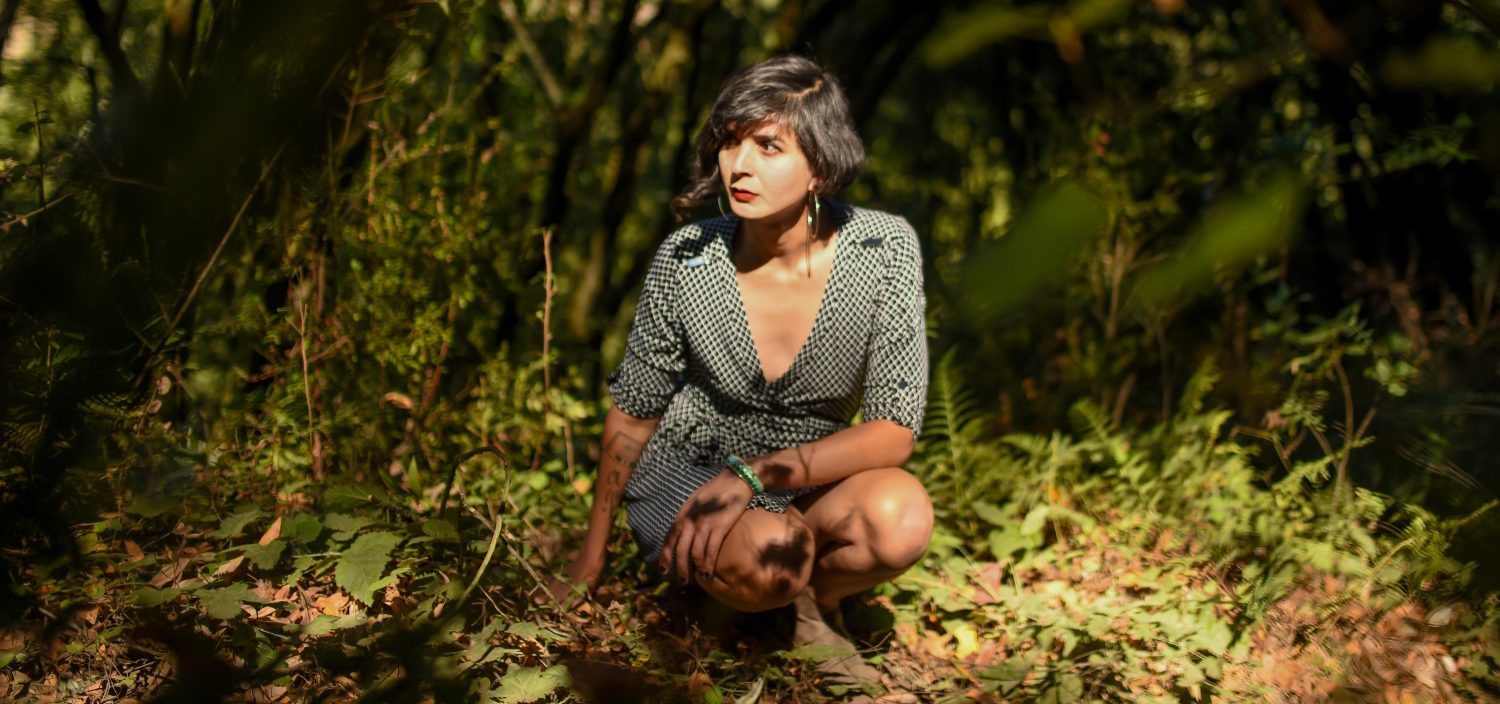
Home sick, working on my website

The sore throat/lost voice I developed immediately after the show Wednesday has yet to abate, so I’ve been taking it easy, drinking lots of throat coat tea and peeing clear. I had the thought that I might try to finish a song I’d been sitting on for a few weeks, then record and post it here–it would be nice if I could harness the compulsory writing schedule here to increase my artistic output–but found it hard to write without singing the parts aloud. So instead I decided to work on my website, which right now is kind of a mess (enough that I don’t really feel the need to link to it here, though of course it can be found). See, I have this urge do-it-myself with a lot of artistic things, sometimes gaining a greater sense of control but sacrificing overall quality, such as my determination to record my own album in 2004.

Setting aside my reasons for coding my own website by hand, there’s one major element in my work that I’ve long wrestled with whether I should do it myself or outsource it to someone with more ability and stick to what I’m best at. I’m talking about my singing, which since at least middle school is something I’ve always done really loudly and exuberantly. I figured out pretty quick that my voice was not naturally strong or particularly pleasant, and though I was always driven to sing for the joy of it, I often felt that I needed to belt in an deliberately obnoxious manner so that it would fit with my general spazzy adolescent persona (which, for those of you who didn’t know me then, was just on a whole ‘nother level from the way I act now) and so that I could somewhat own my bad singing and feel less embarrassed that I was rubbish at something I enjoyed so much.

I sang a wimpy lead in my high school band Clockwork, and bless their hearts, they literally and figuratively stood behind me. Things started to get better once I stopped trying to sing like Thom Yorke, which was simply never going to happen. But even after having obtained a degree in music, singing well is still a challenge for me, especially in terms of pitch accuracy; I sometimes feel like a sharpshooter with decent eyesight but shaky hands.

As a life philosophy, I believe, as Amanda Palmer does, that everyone who can speak should also sing, for themselves and for the world. But this doesn’t necessarily mean that I should be the performer, the principal vehicle for my songs and my words to reach the people who might need to hear them. Certainly there are those who have gotten away with singing their own material, even if they weren’t the best man for the job–Bob Dylan and Conor Oberst spring immediately to mind–and there are also those who find it impossible to listen to these unimpeachable songwriters for that very reason. Bringing us to the far larger dilemma of how much an artist should alter their work to reach a greater audience, and at what point do they stop being true to themselves.

I’ve made the decision to continue singing my own songs, for the time being at least, for a few reasons. Firstly, I haven’t found anyone I would rather handle them. I’ve learned through my experiments over the last year with different musicians that simply because someone may be technically gifted doesn’t mean that they’re the right person to execute your work, and even if I feel like I owe it to my art to find the best people to present it, I also owe it to myself to not give it over to the wrong person. Much of my work is also deeply personal, whether by calling out six people I’ve been romantically linked to by name, or by relating to Barack Obama because of our shared experience of having lost our immigrant father at a young age. I also just have to follow my gut instinct about what I appreciate as a listener. On Conor Oberst (to whom I get compared a lot, for better or worse) and the Mystic Valley Band’s record Outer South, nearly half the songs are penned and sung by other members of the band, and I don’t think there’s really a question as to who’s the least competent vocalist in the group; it’s clearly Conor himself. Yet for the life of me I wouldn’t want to hear any of those other dudes singing his songs.

Last night at the Rockit Room

Last night I played a show at the Rockit Room in the Inner Richmond district of San Francisco. I don’t know that I have anything particularly profound to comment about it, other than that it was important to me, and that as a result I’m sleep-deprived and a little sick today, therefore not feeling particularly moved to do any other deep analysis or commentary.

I’d been excited about this show ever since I landed it a month and a half ago. Truth is, though I’ve considered myself a serious musician for over ten years, everything I’m doing now is pretty new territory for me. It’s the first time in my life I’ve devoted nearly every spare moment to music, and actively sought to create as many extra spare moments as possible. It’s the first time I’ve tried to actively and unabashedly self-promote, the first time I’ve really hustled for gigs. And this was the first paying show at a specifically-for-music (as opposed to food) venue that I’d landed without having any preexisting contact.

The night before my band had our first rehearsal with everyone present. Guy Brown on guitar. Erika Oba on keys. Sarah Thompson backing me up with the vocals. For sure I was nervous about it coming together on short notice, but they’re all superb musicians, very responsive and present with what’s going on in the moment. Just as important, they’re all totally serious about making good music and not dicking around. We got everything together with about three weeks of hastily scheduled rehearsals. We came up with our band name, or rather I suggested four or five I’d had floating around in my head and they ranked them. Right now we’re Shareef Ali and the Radical Folksonomy, which basically speaks to my own obsession with categorizing/relating all that I encounter (see “Wikipedia Brown” as an example) and my belief in the right of common folk to reframe the world in drastic departure from tradition. Anyway, I think we all like the name pretty well, and I hope that some version of it sticks. We agreed to all wear button-downs and jeans, and I brought a supply of bandannas the day of the show so that they might better relate to my own presentation.

I am a fan of all of the groups I asked to play, and none of them disappointed: many thanks to Scotch and Bones, S.A. Bach (and Jonathan and Allie) and the Tenderloins for joining me on the bill last night. For my set, I was joined by the band on four songs: “World’s Oldest Profession”, “The State Of The Garden”, “Red Balloon” and “Broken Record”. It felt amazing to have all these other subtle musical elements woven throughout my songs, adding color, nuance and touches of each of the other players’ personalities. Simply put, the songs are sounding more like they were meant to than they ever have before. I was perhaps even a little distracted during the solo portion of my set because I kept thinking about how great whatever song I was playing was going to sound with everyone else doing their thing on it. As we were playing last night, I was feeling thrilled that we had pulled it off, and even more thrilled by the knowledge that if we could sound that good after just three weeks, how much we had to look forward to as a band. After our set ended, we had a big group hug onstage. I meant it, guys.

Also making my night totally special were all my wonderful friends who came out, not least of all two people who drove up from L.A. (not counting Sebastian and Co.); a buddy from middle school whom I still owe a drink; another friend who lives in SF but I stink at getting back to; and Cortnee Rose from the Starry Plough.

I had sensed earlier in the day that my throat had been feeling a little ticklish, and mid-set I knew that it was getting thin. But I powered through, and promptly afterwards I lost my voice. Today I’m alternating between honking and whispering. I should go to bed and really get serious about recovering, because we’re maybe going to have band practice on Saturday. But I’ve just given myself license to quote Conor Oberst:

You should never be embarrassed by your trouble with livin’; because it’s the ones with the sorest throats, Laura, who’ve done the most singing.

Some thoughts on grief and its treatment in songs

My very close friend Adam just wrote a very candid and thoughtful post in his blog about his ongoing process of grief and remembrance of his sister, who died when we were both in the eighth grade. I remember this time very vividly, not least of all because my own father had died three years earlier. When my friend was faced with his own tragedy, as different as the circumstances of our losses were–my father had had ongoing medical problems–I still related very deeply to him, perhaps sensing that despite these dissimilarities he would understand better than anyone else around me what I had suffered and continued to suffer. I journaled and wrote poems, sharing many of these with Adam. I have sometimes felt ashamed or selfish for having taken a tragic event in his life as an occasion to revisit my own pain, although I’ve forgiven myself somewhat for that, realizing that probably some unconscious part in my 14-year-old self recognized that I still had a lot of healing left to do, healing that perhaps could not have happened at 11, and sprung at the opportunity.

There’s a lot more that I could say about my own long process of grief, which, despite being able to live a rich and satisfying life and consider myself a whole person, I am not certain will ever be done. But what I realized reading Adam’s honest reflection was how superficial and therefore inadequate treatments of grief are in our cultural canon. It’s true that mourning is a deeply personal process and often a very private one, but there’s a fine line between that and secrecy or shame. As far as the medium with which this blog is primarily concerned, songs about the death of a loved one are far less common than those of romance or heartbreak, and with a much more restricted range of acceptable responses, even though I’m inclined to think that the former is the more universal experience.

For my own part, I’ve written dozens of love songs, but only recently have begun to write about my father, despite never having stopped being emotionally affected by his death over the past fifteen years. Part of that is that I want to make sure I get it right, and my relationship to this fact of my life keeps changing. But this isn’t a reservation I have about other people in my life whom I’m moved to write about: I’ve written a song to a lover during our time together, another when it ended and a third when we became close friends again.

Considering, as Adam does, the obligations that I have to myself and/or others who are still alive, it seems imperative that I should write about my loss. I’ve stressed in my past few entries that I consider music to be my contribution to the world: to be more specific, my duty as a songwriter is to render my experiences so that others might be be able to give their pain a shape and a name and realize that these struggles are not theirs alone. The insufficiency of the current body of work addressing this experience seems to demand that I should add my voice, trusting that someone will find themselves in it. Perhaps the most important function of art is to recognize and validate, both to ourselves and to society, feelings about which we might otherwise feel ashamed.

Some thoughts about Amanda Palmer’s thoughts about how fans support artists

I’m going to play to my small blog audience here and post again with regard to Amanda Palmer, who in addition to being a stellar songwriter and performer has some pretty interesting ideas about the music industry and ways in which artists can be supported by their followers and keep doing what they do (more here as well). My overall response is that I quite appreciate that she’s breaking new ground, creating new models, and that I don’t object to anything she’s doing (even though I, despite being a fan, have no interest in buying photos dug out of a shoebox somewhere). Her emphasis on building relationships with fans and thus feeling justified in unabashedly asking for support (and having to strike that delicate balance) actually reminds me a lot of nonprofit fundraising. I do believe that she deserves every bit of support and material reward that she’s getting: because she’s given so much of such great value to so many; because I take her at her word that she’s not living lavishly; and because I believe that she will ‘re-invest’ it in her art.

I’ve spent a lot of time thinking about how a society should support artists. To me, art and entertainment (let me for a moment blur the aesthetic distinction between the two, and ignore the latter’s transformation in our consumerist society) are positively fundamental to the spiritual well-being of a community, and I become outraged anytime I consider how little support artists receive in ours. It seems absurd that artists are expected to work full-time day jobs and cram their expression into all the other hours of the day and night. Romantic though this might seem to some, I believe this prerequisite of suffering and, again, self-sacrifice is a recipe for creative burnout; pursuing one’s dream becomes inextricably linked with drudgery. It bears repeating that I am not opposed (or a stranger to) to hard work, and in fact I believe every able individual should be devoted to lifelong service. But that’s just what art is: service. Of course, not every would-be artist has talent, and there are some very talented artists who fuck around and shouldn’t necessarily be given a free pass. So maybe even hardworking artists should volunteer a reasonable number of hours a week at their community organization of choice, doing something objectively and tangibly beneficial. But the notion of having to have a ‘real’ forty hours a week job to be considered a legitimate citizen is preposterous; across corporate America every day there are millions of respectable workers not doing a fraction of the good that artists are doing to enrich and improve our world.

But this isn’t really what I meant to rant about. Let’s read a little excerpt from Amanda:

it’s also not a matter of whether an artist is starving or cruising on a yacht.
i would hate to see my fans turn on me once i actually have money in the bank with a “well, i would support you if you were starving, but now that you’re eating, no way.”
fuck that.
accept a new system.
feel ok about giving your money directly to paul mccartney. he may be rich, but he still rocks. show you care.
feel ok about giving it to fucking lady gaga if you’ve been guiltily downloading her dance tracks for free.
rejoice in the fact that you are directly responsible for several threads in her new spandex spacesuit.
it shouldn’t matter.
it’s about empowerment and it’s about SIMPLICITY: fan loves art, artist needs money, fan gives artist money, artist says thank you.

I don’t agree with all of that. Well, hang on: I do believe that artists deserve not only to be supported by the community, but also at more than a subsistence level. I certainly wouldn’t want to be Amanda Fuckin’ Palmer, paying my dues in a serious way for a decade, only to find that the more fans I get, the thinner the support gets, the more diminishing the returns. I do believe that for an artist like her, clearly creating something of great value to a large number of people, deserves to live comfortably enough to focus on art most of the time. (Perhaps at a certain point the ten-hours-of-volunteering-a-week is waived?) However, I object to the capitalistic notion that I feel is implicit here, that the number of people willing and able to pay your price for your product (the demand) is intrinsically equivalent to the amount of material return you are entitled to.

Here’s something that one of her responders said, and her follow-up:

i noticed lots of people commented apologizing “i’d love to give you money but i’m a poor student/artist/bastard”….

this is important:
i would never begrudge anyone who can’t give me money. never.

I appreciate that, but I would take it one step further: I would never want anyone to deny themselves my art because they didn’t have the money, or even because they didn’t feel like that was their priority. I create art for myself, yes, but I am a working artist because it’s what I give to the world. People who appreciate my art deserve to have it, even if they can’t or don’t want to pay for it. I’m serious. You know how many Tom Waits albums I own? Three. I love Tom Waits; I want to have his entire collection, to enjoy, to be inspired by (in art and in life), to share with others. You know why I don’t have the entire collection? Of the three albums I have, two of them I acquired the ‘honest’ way. Lemme ask you this: do you think Tom Waits, Shareef Ali, or anybody else benefits from the fact that I’m not able to buy his albums?

Anyway, Amanda is certainly right on that each artist needs to find their own way that is comfortable and effective for them. I’d say that my challenge will be to find a way to ask for support from my followers in a way that doesn’t dissuade people from enjoying the music even if they have nothing to give in return. One thing that’s tricky is that it’s a lot more challenging to leverage people who really could help out a little bit in a trust-based system such as this. There’s an analogy I could draw here about the models of private enterprises in public-oriented sectors, like education, versus non-governmental organizations, but it’s sort of an unnecessary tangent to an already rambling post. Plus, you’re smart folks; you get where I’m going with that, right?

I’m changing the name of my blog.

So it looks like last night I lost the blogging challenge with Cyrus St. Rid. Humph. We’ve discussed it and probably we will continue to hold each other to an every-other-day schedule, since the impetus to continue churning out content that seems at least marginally worthwhile is a positive pressure on both of us. We’ll have to set another challenge goal, and certainly suggestions are welcomed, although I have some doubts as to whether this competition has any followers or interested parties aside from Cyrus and myself.

I’ve been working pretty hard (and I hope, continually harder) at pursuing my musical vision for about the past year. It was in August of 2008 that my good buddy Leif helped me record my demo “Music From And Inspired By Our Doomed Love Affair” at his then-recently acquired Studio 1510. Since then, I’ve been working my way through open mics, cafe shows, and on Wednesday, my first show with the possibility of earning me a small amount of cash (which of course would never be the driving factor but is definitely welcome). But what was I doing between when I graduated with my degree in music in 2005 and August of last year? Some of you know, of course, but I want to document it and reaffirm my commitment to this path that I’m on.

(NOTE: I’ve been sleepwriting now for three hours. I’ve just got to go ahead and publish this imperfect account now and worry about tweaking the history later. You understand.)

Let’s go back to my last two years at Oberlin, when I was in the midst of receiving an excellent music education and well as undergoing a profound transformation of my political consciousness. It was in this time that I realized that my life was and would always be governed by three forces of apparently equal (and immense) strength: the need to work for social improvements, the need to create meaningful art, and the need to pursue personal relationships. More plainly: to fight the good fight, rock out, love and be loved. That last one, Love, had been driving me from an earlier point in my life than either of the others, and I understood that it would always be necessary when working towards either of the other two. But at this point I was torn as to which deserved to be my priority. The simplest way to reduce my qualm is the question, “As much as I love art, how can I justify spending my time creating it when there is so much injustice and oppression in the world?” When I talked about it with other people, whether artist, activists, peers or teachers, the most common response was, “Maybe you can combine them”; a nice thought, although I was and remain skeptical of a lot of art superficially aimed at social change, which, when it fails to inspire, fails doubly, both as an agent for change and as truly moving creative expression.

After graduating, I reasoned that since I had spent four years earning a degree in music, I owed it to myself to pursue that goal, and at the beginning of 2006 moved to L.A. to start a band with S.A. Bach. Although we only played one show, we were totally decent and I’ll always be a little sad that this didn’t work out. Without getting too much into the boring details, by August of 2006 I was working thirteen-hour days, six days a week for an awesome small nonprofit working to provide rehabilitative and support services to homeless women, children and families. This was the beginning of a three-year long ‘career path’ in nonprofit work (specifically fundraising) that came to define my everyday life. In the year between August 2006 and August 2007, I wrote only two songs, and performed not once, nor played music with any other soul. In early 2008 I went to a different (equally worthwhile) organization and worked less insane hours, but my existence still seemed to revolve around my work, where I would often put in extra hours as well as fret about once I went home for the day.

I eventually left nonprofit work, at least for the time being, in May. I realized that as important as the work being done at these agencies was, it wasn’t where I needed to be spending my time and energy. For three years I had been valuing their mission and vision above my own. I had somehow gotten into me the belief that creating art was less valuable than plain honest shoulder-to-the-wheel social justice and activist work. But what I’ve come to realize is that I have a gift, and that (despite my own self-criticism, as well as criticisms from other people of my work) my art is the single most valuable thing I have to offer this world. I’ve known for awhile that I find no other pursuit more personally satisfying, but I would not feel justified in devoting myself to music if it were for that selfish feeling alone.

Although sometimes I feel frustrated or as though I’ve got to make up for lost time, I’m very grateful for the path that I did take through the nonprofits: the crazy hours, the constant self-sacrifice. I learned so much about myself, what I was capable of, and ultimately I credit the journey with turning me from a scrappy, awkward kid into a (still young) man. This journey brought me here, to the Bay Area, where I know I need to be. I’m finally starting to understand what it really means to believe in yourself and commit to your dream. No matter what kind of difficulties I might be facing on my path, I never wonder, “Is this what I should be doing with my life?” So here’s my mantra, and what I’ll be renaming my blog:

No Gods Before Music.

Teenaged Trauma and Salvation Through Music: reflections on Amanda Palmer’s “Oasis”

So as much as I enjoy it when Amanda Palmer writes music to songs penned by her literary giant beau, I LOVE her as a lyricist and pretty much think she’s tops. One of my faves off her solo effort from last year Who Killed Amanda Palmer? was “Oasis”, which I first saw her perform at the Great American Music Hall in San Francisco last summer; come to think of it, I recall that concert being an important moment for me re-realizing that I needed to place no other gods before music.

This song created quite the ruckus last year when the video came out, owing to the flippant treatment of the subject matter of teenaged rape and abortion. I’ll direct you to Amanda’s own comments for a thorough breakdown, but also add a few personal notes about why despite its apparent off-the-cuffness, I believe this is a remarkably thoughtful and well-executed piece.

when I got to the party
they gave me a forty
and I must’ve been thirsty
cause I drank it so quickly

when I got to the bedroom
there was somebody waiting
and it isn’t my fault
that the barbarian raped me

when I went to get tested
I brought along my best friend
Melissa Mahoney
who had once been molested

and she knew how to get there
she knew all the nurses
they were all really friendly
but the test came out positive

I’ve seen better days but I don’t care
I just sent a letter in the mail

when I got my abortion
I brought along my boyfriend
we got there an hour
before the appointment

and outside the building
there were all these annoying
fundamentalist Christians
we tried to ignore them

I’ve had better days but I don’t care
Oasis got my letter in the mail

when vacation was over
the word was all over
that I was a crack whore
Melissa had told them

and so now we’re not talking
except we have tickets
to see Blur in October
and I think were still going

I’ve seen better days but I don’t care
oh I just got a letter in the mail
Oasis sent a photograph
it’s autographed and everything
Melissa’s gonna wet herself
I swear

I realize that as a man commenting on a song like this, I’ve got to tread very carefully. I’ve never lived through the traumatic experiences of the song personally, nor will I ever have to contend with the facts of rape and abortion as ever-present hazards in the landscape. That said, the story told here is one very familiar and even personal to me. More than once I knew girls who were sexually assaulted; one time in particular, a friend’s resulting pregnancy scare prompted me to skip school and walk several miles to buy the test she was too freaked out to get herself. This kind of awful ordeal related in the song has a very clear antecedent from my own history, and the very first time I heard the song I was startled by how real it seemed.

The reason the blunt delivery never struck me as being in poor taste is because I found it so terribly true-to-life. In my experience, teenagers who suffer grotesque losses, violations of self or other indignities are rather prone to blurting about it loudly and plainly in ways which make adults uncomfortable. Also incredibly authentic was the portrayal of her friendship with Melissa, who thinks nothing of breaking confidence about her friend’s hardship to the entire school (the speaker is not necessarily any more loyal, spilling the beans to us about Melissa’s own mistreatment within a breath of introducing her). I quite clearly recall my early best-friendships being marked with mutual betrayals–being old enough to want a close friend for selfish reasons, but not yet knowing how to care for them in return–still they remain BFFs, with an unspoken understanding that their falling-out will be amended by October.

The reason for which, of course, is music. Acknowledging again my removal from the hardest-to-face aspects of it, but isn’t that what the song is really about, what she returns to each chorus, what makes all these unbearable things bearable? Isn’t it about the fact that music quite literally saves people’s lives? When nothing and no one else could do it? I know it did for me. Parents didn’t understand, teachers didn’t care, friends cared but didn’t know how to be real friends yet. In those times, when no one, not you or anyone you knew, could say a single thing to give a name or shape to the fiery hell you were feeling, music was all there was. Without music, would we have screamed until our heads exploded? Bloodied our knuckles against the walls? Well, I did both, but I surely would have with greater frequency if I hadn’t had music to collapse into.

So when I hear this cheery tune, so incongruous with its grim account, I have to say that my main emotional response is gratitude: for music, a true BFF to me and so many who needed it.

Shareef Ali joins the company of Amanda Palmer, Neil Gaiman and Kate Miller-Heidke: Web 2.0 Love Songs

Last year I wrote a tune titled “Wikipedia Brown”, using the format, policy and idiosyncrasies of that wholly addictive interweb entity as a literary vehicle to illustrate various aspects of my romantic past and present.

I did not realize at the time that my title was shared with some bigshot actor-comedian jerk named B.J. Nor was I aware that I was soon to become a pioneer in a groundbreaking new sub-subgenre of love songs: those making explicit mention of Web 2.0 phenomena.

Exhibit A: “Google You”, a forlorn lament penned and set to music by art-star couple Neil Gaiman and Amanda Palmer:

Exhibit B: “Are You Fucking Kidding Me? (Facebook song)”, by Kate Miller-Heidke (who admittedly is otherwise unknown to me):

Despite the surprise and humor of hearing references to relatively new fixtures in our cultural landscape, there’s nothing extraordinary about communications technology making an appearance in our popular sentimental songs. 1899’s “Hello! Ma Baby” mentioned the telephone, developed a mere thirteen years earlier (I hope you’ll presume with me that new gadgets did not pervade our common life so swiftly a century ago). More recently, I recall cocking my head when Billy Corgan sang about Caller ID, or when ‘Licia said in the love rap to “You Don’t Know My Name“: “Hold on, my cell phone breakin’ up”. Though I suppose it’s worth noting that these newest works are distributed virally by the very media used as subjects.

Each of the two examples, however, seem to have clear antecedents in terms of sentiment. “Google You” is a stalker song, not unlike “Every Breath You Take“, while “Are You Fucking Kidding Me?” has clear strains of “I Will Survive” in its lyrical code.

Not to toot my own horn whatsoever, but I’m having a hard time identifying the ancestor to my own number. Can anybody think of a song that obsessively catalogues one’s amorous trials and triumphs without analogizing to an interactive, collaborative, user-oriented information hub? Do you know of any other Web 2.0 love songs, so that our new musical movement may have more than three hallmark compositions?

Okay, for the (first and) last time: here’s what the cowboy thing is about.

After my last post extolling the virtues of country music, now seems like as good a time as ever to put down on record an explanation of my current presentation/performing identity of Shareef Ali, the cowboy poet.

Although many of my new friends on the Bay Area songwriter/performer scene have rarely seen me out of a wide-brimmed hat, well-worn jeans and a shirt with snaps, the truth is I wasn’t always a cowboy, nor am I always one at every moment of my present life. I put on my first cowboy outfit before diving back into music in mid-2008 (a Thursday night open mic at Bazaar Cafe), and since then I’ve very seldom been without it when I’m playing. A few people have even failed to recognize me when seeing me in my civilian garb. But why do I do it?

Of course a large part of it is in homage to the oft-disregarded role of country in our musical history. It’s also about laying claim to an identity, perhaps the most quintessentially American cultural identity that exists. There are some who might object to whether my claim is legitimate, to whom I contend that the cowboy image has been so widely disseminated/appropriated by many that have little to do with ‘authentic’ cowboy culture that the entire notion is as much defined by this ether (including a good deal of popular country culture) as it is by bona fide modern cowboys working in the cattle industry. For my part, I’ve spent the greatest part of my twenty-seven years living in Middle America and feel pretty well acquainted with what the heart of this country is all about. A lot of people I know, especially here in California, have a similar feeling about America as they do about country music: disdain or at least mild embarrassment (though admittedly this has abated some since Bush left office). I won’t say I’m unfamiliar with this myself, but I refuse to disown either my country or one of its most significant styles of indigenous music. To me they’re like family, and even if some of your family embarrasses you sometimes or acts like an ass, they’re family all the same (sorry, family; much love to you). And for a Man Of Half-Asian Half-Middle Eastern Descent (MOHAHMED, if that helps you remember) like myself, with a name like Shareef Ali, who at times has to fight tooth-and-nail to be recognized as being as American as the next chump, putting on this hat and boots is something of a radical act. Plus I do enjoy the way that it resets people’s expectations, so that when I finally get up in front of that microphone, there’s a nice, “Huh. Didn’t really expect to hear that” effect.

At least, that was what was going through my head when I decided to suit up as a cowboy a year and a half ago. Now, it just feels comfortable; I’m not quite myself if I go out to play without my colors. Whether I’ll stick with it, time will tell. Let me leave you with a little bit from my recent song, “Golden Birthday“. It’s probably the most self-referential and time-specific song I will ever pen; super-rough demo here, recorded on my actual birthday shortly after finishing it. It basically says most of what I just related here, in more flowery language.

Twenty-seven this day my dad gave me a name:
Shareef, and like his dad, Ali.
Although he didn’t know twenty-seven ago
you can guess from my garb what I be.

Give a cowboy some company
on this day of his birth.
For though he’ll always be lonely,
at least he won’t know what’s worse.

Rule number one among cowfolk:
you don’t ask what he is, where he’s from.
If you’ve never seen that in heels and a hat,
trust you’ll see plenty more ‘fore he’s done.

Chorus

Don’t tell me the day is still young, miss;
ten men mean to kill me at noon.
Though I don’t pretend I’ll escape in the end,
they might wait if they see me with you.

Chorus

Truth is, I wasn’t born beneath this brim,
and I ain’t gonna die in these boots.
Mine is a vine that you can’t unentwine,
stolen sunshine and borrowed roots.

Chorus

And we each got our burdens to shoulder,
and we each got our trails to keep on.
And it’s easy to forget how to chase a sunset
when you know you have to get up at dawn.

Chorus

Give a cowboy some company
on this day of his birth.
For though he’ll always be ornery,
trust he knows what it’s worth.

A Modest Defense Of Country Music

I’ve been defending country music from its detractors for several years now. While there are somewhat fewer critics than there were before (some of these hipsters can get their appropriating fingers into anything), and people have come to expect this position from me more since I adopted my cowboy garb, I think it’s safe to say that most young people growing up in a metropolitan setting like to turn their noses up at it. (One exception is for people who listen to mostly pop of a variety of genres including pop country, with their Carrie Underwood nestled right there between Beyonce and John Mayer.) Let me go on record as to why I appreciate this music:

1. Its clear critical place in American musical history, namely as an important antecedent to rock and roll.
2. The way them country guitar cats can cut! Whoo-whee!
3. A lovely balance of sounds that strike me as very organic.
4. The SONGWRITING.

Of course, this last bit is what I’m going to hone in on. This I’ll say even in defense of pop country: they have a clear standard for what a song is supposed to consist of and accomplish, and the bar is set high. As someone who grew up in and then out of late ’90s/early 2000s ‘alternative rock’, I remember my disillusionment peaked when I heard, in 2002, this awful offering by Trapt called “Headstrong“, which must be quoted in its entirety to make my point:

Circling your, circling your, circling your head
Contemplating everything you ever said
Now I see the truth I got a doubt
A different motive in your eyes
And now I’m out, see you later

I see your fantasy
You want to make it a reality paved in gold
See inside, inside of our heads, yeah
Well, now that’s over

I see your motives inside
Decisions to hide

Back off, I’ll take you on
Headstrong to take on anyone
I know that you are wrong
Headstrong, we’re headstrong

Back off, I’ll take you on
Headstrong to take on anyone
I know that you are wrong
And this is not where you belong

I can’t give everything away
I won’t give everything away

Conclusions manifest, your first impression’s
Got to be your very best
I see you’re full of shit and that’s alright
That’s how you play, I guess you get through
Every night, well, now that’s over

I see your fantasy
You want to make it a reality paved in gold
See inside, inside of our heads, yeah
Well, now that’s over

I see your motives inside
Decisions to hide

Back off, I’ll take you on
Headstrong to take on anyone
I know that you are wrong
Headstrong, we’re headstrong

Back off, I’ll take you on
Headstrong to take on anyone
I know that you are wrong
And this is not where you belong

Where you belong?
(I can’t give everything away)
This is not where you belong
(I won’t give everything away)

I know, I know all about, I know, I know all about
Your motives inside and your decision to hide

Back off, I’ll take you on
Headstrong to take on anyone
I know that you are wrong
Headstrong, we’re headstrong

Back off, I’ll take you on
Headstrong to take on anyone
I know that you are wrong
And this is not where you belong

Where you belong?
This is not were you belong
(I can’t give everything away)
This is not were you belong
(I won’t give everything away)
This is not were you belong

(UPDATE: I’ve been told by a discerning reader that quoting this song in full is quite a dull read. That’s kind of the point though.)

Thinking back, I think I was listening to an acoustic version of the song on the radio, the purpose of which is ostensibly to call greater attention to the dismal (both in tone and execution) lyrics. This new focus, combined with the tireless repetition of the title lyric, led me to exclaim aloud (to myself, in the car), “Jesus Christ, what the fuck are you even talking about? Do you even know?”

It’s really a dreadful state of affairs. There have been atrocious songwriters for ages, of course, serving up insipid cliche after insipid cliche, but emo-nu-metal is unique in that the songwriters really truly cannot say what their songs are about, save a general feeling of alienation and despair. (Note: Certain drug-inspired ballads of the ’60s and ’70s may seem to be on the same level here, but a) they are clearly about drugs and nothing more b) they either make sense high or are designed to fuck your mind; either way, they succeed as compositions.) I’m also reminded of Papa Roach’s breakout smash “Last Resort”, wherein the speaker relates, “Don’t give a fuck if I cut my arm bleeding” and “If I took my life tonight, chances are that I might”; he then elaborates, “Mutilation out of sight. And I’m contemplating suicide.” Even in the spectrum of angst, this is a severely limited palette of sentiments.

It’s unnecessary to continue ripping these types of songs, but I offer it simply as a counterpoint to a modern country song: “Tequila Makes Her Clothes Fall Off” by Joe Nichols.

Before I even continue to the lyrics, notice: see how you already know what this song’s about?

She said, “I’m going out with my girlfriends”
Margaritas at the Holiday Inn
Lord have mercy, my only thought
Was Tequila makes her clothes fall off

I told her put an extra layer on
I know what happens when she drinks Patron
Her closet’s missing half the things she’s bought
Tequila makes her clothes fall off

Chorus:

She’ll start with kickin’ out of her shoes
Lose an earring in her drink
Leave her jacket in the bathroom stall
Drop a contact down the sink
Them pantyhose ain’t gonna last too long
If the DJ puts Bon Jovi on
She might come home in a table cloth
Tequila makes her clothes fall off

She can handle any champagne brunch
A bridal shower with Bacardi punch
Jello shooters full of Smirnoff
But Tequila makes her clothes fall off

Chorus

She don’t mean nothing – she’s just havin’ fun
Tomorrow she’ll say, “Oh, what have I done?”
Her friends will joke about the stuff she lost
Tequila makes her clothes fall off

Like a third-grader who already gets exactly why the hamburger outline makes sense and has a well-developed main idea, supporting details and conclusion (who can guess what this songwriter’s day job is?), there’s just a huge sense of relief I feel when I hear a song and I can comfortably state, “Whoever wrote that song knew what they wanted to say.”

Let’s look at one more: “Cleaning This Gun (Come On In Boy)” by Rodney Atkins.

The Declaration of Independence
Think I could tell you that first sentence
But then I’m lost

I can’t begin to count the theories
I’ve had pounded in my head
That I forgot

I don’t remember all that Spanish
Or the Gettysburg address
But there is one speech from high school
I’ll never forget

Chorus:

Come on in boy sit on down
And tell me about yourself
So you like my daughter do you now?
Yeah we think she’s something else
She’s her daddy’s girl
Her momma’s world
She deserves respect
That’s what she’ll get
Ain’t it son?
Hey y’all run along and have some fun
I’ll see you when you get back
Bet I’ll be up all night
Still cleanin’ this gun

Well now that I’m a father
I’m scared to death one day my daughter
Is gonna find
That teenage boy I used to be
That seems to have just one thing on his mind

She’s growin’ up so fast
It won’t be long before
I’ll have to put the fear of god into
Some kid at the door

Chorus

Now it’s all for show
Ain’t nobody gonna get hurt
It’s just a daddy thing
And hey, believe me, man it works

Chorus

Son, now y’all buckle up and have her back by te- let’s say about nine…thirty.
Drive safe.

That’s the best I can do before the stroke of midnight. Curse the restrictions of this blogging challenge! But seriously, come on. You know you love country.

Shareef Ali hands down judgment of millenium anthems nearly a decade late

It seems that a common rite of passage in blogging is to tip someone’s dozing sacred cow, and this may be my first blaspheme. Thanks to Melissa Gira for our conversation last month, in which we determined that Pulp’s “Disco 2000” was a far superior end-of-millenium anthem than Prince’s “1999“.

Here’s the video to the former, a bit different than the version on the album, but an entertaining watch anyway:

Now I know, these are apples and oranges; Pulp’s tune is a bleak tale of unrequited love with a chance of redemption at the end, while Prince’s is a doomsday party song; I can’t help it if I categorically value the best of the former genre over the best of the latter. Still, let’s consider them side-by-side. “1999” of course is a far more widely canonized work; we’re all familiar with its basic sentiment of ‘getting one’s kicks before the whole shithouse goes up in flames’. The notion of end times gets no play in “Disco 2000”, penned some twelve years nearer to the close of the century. Most of the song is spent reflecting on times past; the year 2000 is only relevant in contrasting the childhood wonder and hope for the future with the dreary reality of the present. (Side note: I was introduced to this song late in high school, and so tend to associate it with Chris Rock’s disillusioned opening monologue at the 1999 MTV Video Music Awards, around 2:18 in the clip).

The really lovely bit of “Disco 2000” is the very end, where, despite the past filled with shyness and shame, years of desperation, and the indignities of growing up, the speaker dares to look for a spark with his old crush. So while Prince is all, “Shit’s almost over, but this is gonna be awesome,” Jarvis Cocker and company shrug and say, “It’s not awesome. It’s never been awesome; it’s been quite rubbish. But it’s not over, we’re still here, so let’s try this.” There’s something brave to me about that small, glum hope.