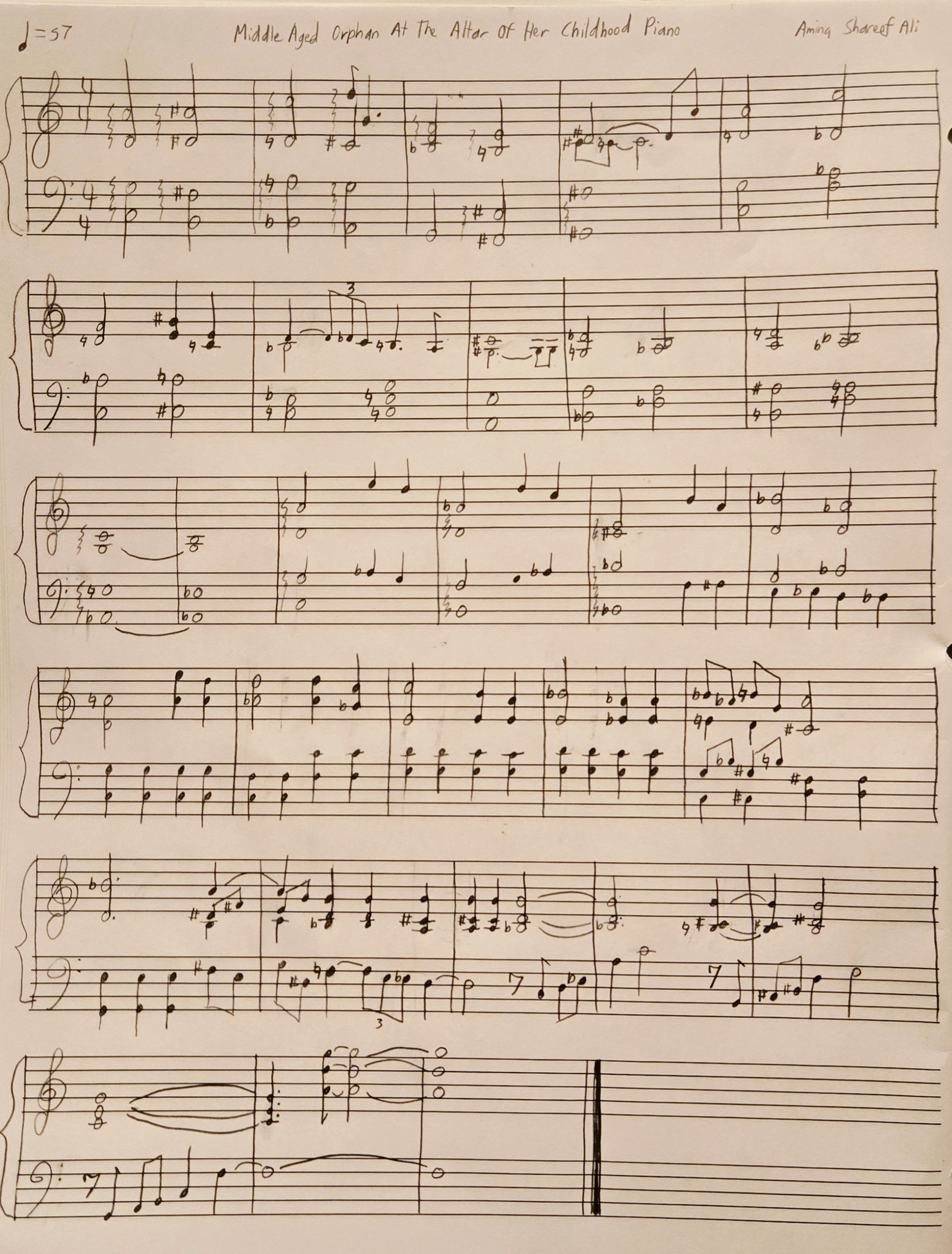
I referenced this in passing in my 2025 retrospective, but I’ve finally gotten around to writing out properly my first real (instrumental, in a “classical” or adjacent style) composition since I was in undergrad! In case you didn’t know, I studied music composition at Oberlin, which was both totally mind-bending and overall (trans)formative for me, and also a hugely uncomfortable warping out of any creative mode I had ever explored before. I think a full accounting of what that education taught me, what I value and what I reject, is…something I’ll delve more into some other time, maybe.
What I’ll say is this. As expansive as that period was for me, there had already been another kind of pruning happening of other creative modes (art, writing). Some logic that I had to both hone one particular craft and otherwise stay in my lane had already taken hold, and wouldn’t really let go until 2015 or so. And you know what, it wasn’t the worst thing in the world; it was during this time that I really went into the woodshed as a songwriter, and maybe I couldn’t have become the songwriter I am without it. But somewhere in there I lost a sense of play: not just in the sense of noodling in a low-stakes way, but also just getting curious, feeling into deeper experience, not judging.
“Middle Aged Orphan at the Altar of Her Childhood Piano” is just that. Two and a half years ago, a year before she died, my mom shipped out to me, at significant expense, the piano that had been my dad’s tenth wedding anniversary present to her. My brother and I both took lessons for years on it. And for the first time, I had a home where I not only had space for it, but could play it at any time of day or night. And as the title suggests, it doubles as an altar. I sometimes sit here for five minutes, or twenty, at the end of a night, communing with my parents, and feeling into the sounds that come out, how they sound together, how they move against one another, where they pull and rest. And it feels very good to come back to this register of creativity, but with two decades (!) of life and maturity under my belt, nothing to prove anymore (musically, anyway).
I started out improvising the first chordal phrase (after Satie’s “Chorale Inappetisant”), and then made some decisions* about the the piece and my method: 1) it would be a chorale with four voices; 2) I would mostly follow my ear and not analyze what I was writing in real time with chord functions etc. 3) voice leading over chord spelling; 4) I would be able to play it (I’m still not up to snuff with a recording for socials, but I’ll get there soon). Also, I made the decision not to fuss with ‘proper’ functional spelling of certain harmonies~ C-flat and so on~ because I think the tonal centers are murky enough to not really be worth the trouble.
Okay, without further ado~
*per my late teacher Randy Coleman, “The first step of creativity is constraint.” Inna lillahi wa inna ilayhi raji’un.
 Amina Shareef Ali